top of page

April 19, 2026
On this page you will find:
The readings for Mass, the Mass leaflet with the choice of hymns
A sample universal prayer available for download, in PDF and editable Word formats.
A meditation on the Sunday Gospel, a spiritual text and commentary by Marie-Noëlle Thabut
3rd Sunday of Easter
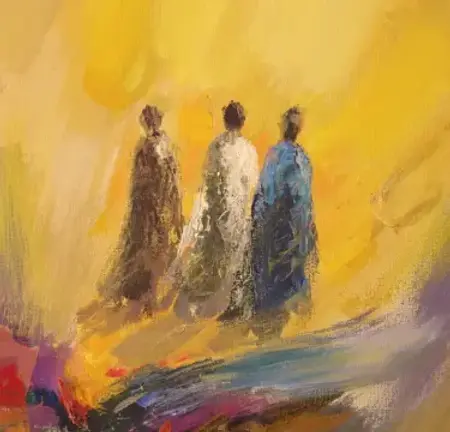
"Were not our hearts burning within us,
while he was talking to us on the road
and opened the Scriptures to us?
Luke 24:32
Readings from the Mass
Mass leaflet
Universal Prayer
Consult the Lectio Divina page, which invites you to read the Gospel in a prayerful atmosphere so that you may be touched in your heart. It is important not to rush to read commentaries or homilies before having this personal experience of encountering Christ in Scripture.
Next, if you wish, you can read the meditations below which will enrich your personal reading and meditation.
HOMILY OF POPE FRANCIS
Today, the Gospel reading for the third Sunday of Easter tells us about the journey of the two disciples on the road to Emmaus who left Jerusalem. A Gospel that can be summarized in three words: death, resurrection, and life.
Death: The two disciples return to their daily lives, filled with disappointment and despair: the Master is dead, and therefore there is no point in hoping. They were disoriented, blinded, and disillusioned. Their path is a step backward; it is a distancing from the painful experience of the Crucified One. The crisis of the Cross, even the "scandal" and "folly" of the Cross (cf. 1 Cor 1:18; 2:2), seems to have buried all their hope. The one on whom they had built their lives is dead, defeated, taking all their aspirations with him to the grave.
They could not believe that the Master and Savior who had raised the dead and healed the sick could end up hanging on the cross of shame. They could not understand why Almighty God had not saved him from such a ignominious death. Christ's cross was the cross of their ideas about God; Christ's death was a death of what they imagined God to be. They, in effect, were the ones who were dead in the grave of the limitations of their understanding.
How often does man paralyze himself, refusing to overcome his idea of God, of a god created in the image and likeness of man; how often does he despair, refusing to believe that the omnipotence of God is not the omnipotence of force, of authority, but that it is only the omnipotence of love, forgiveness, and life!
The disciples recognized Jesus in the breaking of the bread, in the Eucharist. If we do not allow the veil that obscures our eyes to be broken, if we do not break the hardness of our hearts and our prejudices, we will never be able to recognize the face of God.
Resurrection: In the darkness of the deepest night, in the most overwhelming despair, Jesus approaches the two disciples and walks with them so that they may discover that he is “the Way, the Truth, and the Life” (Jn 14:6). Jesus transforms their despair into life, for when human hope disappears, divine hope begins to shine forth: “What is impossible with man is possible with God” (Lk 18:27; cf. 1:37). When a person reaches the depths of failure and inadequacy, when they shed the illusion of being the best, of being self-sufficient, of being the center of the world, then God reaches out to them to transform their night into dawn, their affliction into joy, their death into resurrection, their journey into a return to Jerusalem—that is, to life and to the victory of the Cross (cf. Heb 11:34).
Indeed, the two disciples, having met the Risen Lord, returned full of joy, confidence, and enthusiasm, ready to bear witness. The Risen Lord had raised them from the tomb of their unbelief and affliction. In meeting the Crucified and Risen One, they found the explanation and fulfillment of all Scripture, the Law, and the Prophets; they found the meaning of the apparent failure of the Cross.
Those who do not pass through the experience of the Cross to the Truth of the Resurrection condemn themselves to despair. Indeed, we cannot encounter God without first crucifying our limited ideas of a god who reflects our understanding of omnipotence and power.
Life: The encounter with the risen Jesus transformed the lives of these two disciples, because encountering the Risen One transforms all life and makes fruitful all barrenness (cf. Benedict XVI, General Audience, Wednesday, April 11, 2007). Indeed, the Resurrection is not a faith born in the Church, but the Church was born of faith in the Resurrection. Saint Paul says: “If Christ has not been raised, our preaching is useless and so is your faith” (1 Cor 15:14).
The Risen Lord disappears from their sight, to teach us that we cannot contain Jesus in his visible, historical form: “Blessed are those who have not seen and yet have believed” (Jn 21:29; cf. 20:17). The Church must know and believe that he lives with her and gives her life in the Eucharist, in the Scriptures, and in the Sacraments. The disciples on the road to Emmaus understood this and returned to Jerusalem to share their experience with others: “We have seen the Lord… Yes, he has truly risen!” (cf. Lk 24:32).
The experience of the disciples on the road to Emmaus teaches us that it is not worthwhile to fill places of worship if our hearts are empty of the fear of God and his presence; it is not worthwhile to pray if our prayer to God is not transformed into love for our neighbor; much devotion is not worthwhile if it is not animated by much faith and much charity; it is not worthwhile to cultivate outward appearances, for God looks at the soul and the heart (cf. 1 Sam 16:7) and detests hypocrisy (cf. Lk 11:37-54; Acts 5:3-4) [1] . For God, it is better not to believe than to be a false believer, a hypocrite!
True faith is that which makes us more charitable, more merciful, more honest and more humane; it is that which animates hearts to lead them to love everyone freely, without distinction and without preferences; it is that which leads us to see in the other not an enemy to be defeated, but a brother to be loved, served and helped; it is that which leads us to spread, defend and live the culture of encounter, dialogue, respect and fraternity; which leads us to the courage to forgive the one who offends us; to extend a hand to the one who has fallen; to clothe the naked; to feed the hungry; to visit the prisoner; to help the orphan; to give drink to the thirsty; to go to the aid of the elderly and those in need (cf. Mt 25:31-45). True faith is that which leads us to protect the rights of others with the same strength and enthusiasm with which we defend our own. In fact, the more we grow in faith and knowledge, the more we grow in humility and in the awareness of our own insignificance.
Dear brothers and sisters,
God only values faith professed through life, because the only extremism accepted by believers is that of charity! Any other form of extremism does not come from God and does not please Him!
Now, like the disciples on the road to Emmaus, return to your Jerusalem—that is, to your daily life, your families, your work, and your beloved homeland—filled with joy, courage, and faith. Do not be afraid to open your heart to the light of the Risen Lord and let Him transform your uncertainty into a positive force for you and for others. Do not be afraid to love everyone, friends and enemies alike, for it is in lived love that the strength and treasure of the believer reside!
May the Virgin Mary and the Holy Family, who lived on this blessed land, enlighten our hearts and bless you and dear Egypt, which, at the dawn of Christianity, welcomed the evangelization of Saint Mark and has given throughout history many martyrs and a great procession of saints!
Al Massih Kam/ Bilhakika kam – Christ is risen/ He is truly risen!
[1] Saint Ephrem exclaims: “But tear away the mask that covers the hypocrite and you will see nothing but rot” ( Serm .). “Woe to him who has a double heart,” says Ecclesiasticus (2, 14, Vulg.).
AR - DE - EN - ES - FR - IT - PL - PT
APOSTOLIC JOURNEY OF POPE FRANCIS
IN EGYPT
(April 28-29, 2017)
MASS
HOMILY OF THE HOLY FATHER
Air Defense Stadium, Cairo
Saturday, April 29, 2017
[ Multimedia ]
Homily
Draw from the source
The readings for this Sunday offer us testimonies about the resurrection of Jesus. First, we have the testimony of the Apostle Peter (first reading). In his life, there was a radical change. We recall his response when Jesus announced his Passion, death, and resurrection. He couldn't bear the thought. It didn't fit with his understanding of the Messiah. And when Jesus was arrested, he was so afraid for his life that he declared he wasn't part of his group.
But on the day of Pentecost, everything changed: the apostles received the Holy Spirit. From then on, Peter could testify with strength and courage: “This Jesus, whom you put to death on the cross, God raised from the dead.” His death was not a failure. He is alive forever; all of this was foretold in the Scriptures—Moses, the Psalms, the Prophets. From now on, the entire Old Testament must be reread in the light of Jesus’ resurrection. This good news was first proclaimed to the Jewish people, and then very soon after to the Gentiles. The whole world must know this: with Jesus, death does not have the final word; God’s plan leads to life.
This appeal from Peter is echoed in the second reading: this Jesus who died and rose again is the savior of all humanity. It is not gold and silver that have redeemed us from the superficial ways of our ancestors; it is through the precious blood of Jesus Christ that we are purified; it is for us and for all that he offered his life and shed his blood. His love surpasses all we can imagine. We are invited to receive this letter as a call to true conversion.
The Gospel takes us back to the third day after Jesus' death: two disciples were returning from Jerusalem. They had witnessed the Passion and death of their master. For them, it was all over. It was the end of a great hope. Saint Luke specifies that one of them was named Cleopas; he doesn't give the name of the second. But if we reread this Gospel in our own context, we can say that this second disciple represents each one of us.
Indeed, we are often like that disciple marked by sadness and discouragement. This is what happens when we see our daily lives as a defeat: the defeat of the Gospel for persecuted Christians, for the poor, the excluded, the victims of violence, wars, loneliness, and abandonment. This defeat is also when we say that, at this point, there is no longer any hope.
But then, on the road to Emmaus, Jesus approached his followers and joined them. They didn't recognize him: their eyes were blinded by sadness and disappointment. The same Christ meets us on our paths. When everything is going wrong, he is there. But too often, we don't recognize him because we are preoccupied. And yet, he is always there, ready to listen to us. We can cry out to him our suffering, our disappointment, our sadness.
It is then that he intervenes to explain the Scriptures to us, Moses, the prophets… This is what we are all called to: to welcome Christ, to allow ourselves to be transformed by his Gospel. Saint Luke specifies that the disciples' hearts burned within them as he spoke. This is what the prophet Isaiah foretold: “…my word that goes out from my mouth will not return to me empty, but will accomplish what I desire and achieve the purpose for which I sent it.” This is also what we can ask of the Lord: that our hearts may be filled with the love that flows from his heart.
In this Gospel, we discover another stage: the disciples' request, "Stay with us!" Such an encounter cannot end there. Then their eyes are opened, and they recognize him. To recognize the risen Christ, present in our lives, we need the gaze of faith, a faith warmed by the Word of God and the Eucharist. It is in this way that the risen Christ meets us in the heart of our lives to rekindle and strengthen our hope.
And when we have recognized and welcomed the living Christ, we cannot keep it to ourselves; we want to proclaim it to the world. At the end of this Mass, we will be sent out to bear witness, before everyone, to the faith that animates us. We cannot be content to remain among ourselves within the Church. Our witness must reach all people, especially those on the margins.
On this day, we welcome the words of this song:
Go out into the squares and the forecourts!
Go out to the public squares and look for my friends there.
All my children of light who live in the night,
All the children of my Father, separated from Him,
Go out into the public squares and be my witnesses, every day.
Understanding the readings
with Marie-Noëlle THABUT
bottom of page

