
Saint Gertrude Parish - Lasne

Words of Hope
January 19, 2026

We have just begun Ordinary Time, a time when we are called to nurture our relationship of friendship with God in the daily course of our lives and commitments. May we place personal prayer at the heart of each day, so that we may hear the Word of God resonate within us and experience a genuine filial relationship with Him.
January 6, 2026

Dear friends, the hope we proclaim must be grounded in reality: it comes from heaven, but to bring forth a new story here below. So, let us see in the gifts of the Magi what each of us can share, what we can no longer keep to ourselves but share, so that Jesus may grow among us. May his Kingdom grow, may his words be fulfilled in us, may strangers and adversaries become brothers and sisters, may inequality give way to equity, may the industry of war yield to the craft of peace. Weavers of hope, let us set out toward the future by a different path (cf. Mt 2:12).
SOLEMNITY OF THE EPIPHANY OF THE LORD
POPE LEO XIV
ANGELUS
Central loggia of St. Peter's Basilica
Tuesday, January 6, 2026
January 1, 2026

Brothers and sisters, if Christian prayer is so profoundly Marian, it is because in Mary of Nazareth we see one of us giving birth. God made her fruitful and she came to meet us with his likeness, as every son resembles his mother. She is the Mother of God and our Mother. We say "Our hope" in the Hail, Holy Queen. She resembles the Son, and the Son resembles her. And we, we resemble this Mother who gave a face, a body, and a voice to the Word of God. We resemble her because we can give birth to the Word of God here below, transforming the cry we hear during childbirth. Jesus wants to be born again: we can give him body and voice. This is the birth that Creation awaits.
To hope is to create. To hope is to see this world become God's world: the world in which God, human beings, and all creatures walk together again, in the garden city, the new Jerusalem. May Mary, our hope, always accompany our pilgrimage of faith and hope.
LEO XIV
December 28, 2025

The Jubilee is drawing to a close, but the hope this year has given us does not fade: we will remain pilgrims of hope! We have heard from Saint Paul: “Our salvation is in hope” (Romans 8:24). Without hope, we die; with hope, we come to the light. Hope is generative. Indeed, it is a theological virtue, that is, a power of God, and because it begets, it does not kill but brings forth and rebirth. This is true power. That which threatens and kills is not power: it is omnipotence, it is aggressive fear, it is an evil that begets nothing. The power of God brings rebirth. This is why I would like to tell you: to hope is to beget.
LEO XIV
December 24, 2025

When Christmas is at hand, we can say: the Lord is near! Without Jesus, this statement—the Lord is near—might sound almost like a threat. In Jesus, on the contrary, we discover that, as the prophets had foreseen, God is a bosom of mercy. The Child Jesus reveals to us that God has a heart of mercy, through which he constantly gives birth. In him there is no threat, only forgiveness.
LEO XIV
JUBILEE AUDIENCE
CATECHESIS OF POPE LEO XIV
Saint Peter's Square
Saturday, December 20, 2025
December 19, 2025

We are absorbed by so many activities that don't always bring us satisfaction. Many of our actions involve practical and concrete matters. We must fulfill numerous commitments, solve problems, and face difficulties. Jesus, too, was deeply involved with others and in life, sparing no effort, giving himself completely. Yet, we often perceive that doing too much, far from fulfilling us, becomes a dizzying whirlwind that robs us of serenity and prevents us from fully experiencing what truly matters in our lives. We then feel tired and dissatisfied: time seems to dissipate into a thousand practical things that, nevertheless, fail to penetrate the ultimate meaning of our existence. Sometimes, at the end of busy days, we feel an emptiness. Why? Because we are not machines; we have a heart—or rather, we might say, we are a heart.
The heart is the symbol of our entire humanity, a synthesis of thoughts, feelings, and desires, the invisible center of our being. The evangelist Matthew invites us to meditate on the importance of the heart, quoting this beautiful phrase from Jesus: "For where your treasure is, there your heart will be also" (Mt 6:21).
LEO XIV
Saint Peter's Square
Wednesday, December 17, 2025
December 16, 2025

The word of Jesus frees us from the prison of discouragement and suffering: every prophecy finds its expected fulfillment in Him. It is Christ, in fact, who opens humanity's eyes to the glory of God. He gives voice to the oppressed, from whom violence and hatred have silenced their voices; He overcomes the ideology that deafens us to the truth; He heals the appearances that distort the body.
The Word of life thus redeems us from the evil that leads the heart to death. Therefore, as disciples of the Lord, we are called during this Advent season to unite the expectation of the Savior with attentiveness to what God is doing in the world.
LEO XIV
ANGELUS
Saint Peter's Square
Third Sunday of Advent
December 14, 2025
December 15, 2025

“Rejoice in the Lord always” ( Philippians 4:4). Let us rejoice, then, for Jesus is our hope, especially in times of trial, when life seems to lose its meaning and everything appears darker…
LEO XIV
ANGELUS
Saint Peter's Square
Third Sunday of Advent
December 14, 2025
December 13, 2025
"The wolf will live with the lamb, the leopard will lie down with the goat, the calf and the lion cub will feed together, and a little child will lead them" (Isaiah 11:6).
Brothers and sisters, how the world needs this hope! Nothing is impossible for God. Let us prepare ourselves for his Kingdom, let us welcome it. The least of them all, Jesus of Nazareth, will guide us! He shines upon our history like the rising sun, he who placed himself in our hands, from the night of his birth until the dark hour of his death on the cross. A new day has begun: let us awaken and walk in his light!
This is the spirituality of Advent, so luminous and tangible. The lights along the streets remind us that each of us can be a small light if we welcome Jesus, the seed of a new world. Let us learn to do so from Mary, our Mother, woman of trusting expectation and hope.
LEO XIV
ANGELUS
Saint Peter's Square
Second Sunday of Advent,
December 7, 2025
December 12, 2025

The mystery of the Incarnation of the Divine Word is the revelation of the love that God the Father has for each of us. As Pope Benedict XVI wrote in his first encyclical , published on Christmas Day itself, “this action of God now takes its dramatic form in the fact that, in Jesus Christ, God himself pursues the ‘lost sheep,’ suffering and lost humanity.” [1] God who becomes a child, who entrusts himself to the care of human parents, who offers himself for each of us, is the icon of the divine love that comes to save us.
What joy to be able to say with heart and mind: God is charity, he is love! (cf. 1 Jn 4:16). By looking at him, we can learn to love as he has loved us; we can discover that the commandment of love meets our most authentic needs, for it is when we love that we truly find fulfillment.
LEO XIV
ADDRESS OF THE HOLY FATHER LEO XIV
TO THE ORGANIZERS AND ARTISTS OF
“CONCERT WITH THE POOR”
Clementine Room
Friday, December 5, 2025
December 11, 2025

Brothers and sisters, the mystery of death has always stirred profound questions in humankind. It appears as the most natural and, at the same time, the most supernatural event that exists. Many ancient peoples developed rites and customs related to the worship of the dead to accompany and remember those who were passing into the ultimate mystery. Only human beings ask themselves questions about death because only they know that they must die. Saint Alphonsus Liguori, in his famous work *Preparation for Death*, reflects on the pedagogical value of death, showing how it is a teacher of life. Knowing that death exists teaches us to choose what we want to do with our lives. The event of Christ's Resurrection reveals that death is not opposed to life, but is part of it, a passage to eternal life. The Passover of Jesus gives us a foretaste of the fullness that will come after death. Death is not the end, but the passage to the full light, to blessed eternity.
LEO XIV
GENERAL AUDIENCE
Saint Peter's Square
Wednesday, December 10, 2025
December 8, 2025

This is the dawn before the day,
Here is the virginal mother.
The woman promised at the beginning of time,
She built her house
In accordance with the Father's wishes.
No fear, no refusal
Let nothing disturb the work of grace,
Her heart is filled with ineffable longing,
She offers silence to God
Where the Word dwells.
December 7, 2025

“Bear fruit that reflects your conversion,” John the Baptist tells us. Praying every day and going to Mass is good. It's even essential. But the fruits God expects from us also include respect for others, sharing with the hungry and cold, the courage to forgive those who have hurt us; and fighting against everything that destroys a person, a group, or a society. We sometimes hear about weapons of mass destruction. It's true they exist and they cause harm. But those that most annihilate our world are selfishness, indifference, social injustice, and financial scandals that plunge the poorest into poverty. Preparing for the Lord's coming into our lives and our world involves acts of welcome, sharing, and reconciliation.
It is in these acts of love and sharing that we recognize the presence and action of the Holy Spirit. They are a sign that God is already among us. We too are invited to welcome Him and all our brothers and sisters. On this day, John the Baptist directs us to the One who will baptize with the Holy Spirit and fire. Through this baptism, He gives us an extraordinary power of renewal and re-creation, capable of transforming even the greatest sinners into saints. This fire spoken of in the Gospel is the fire of love that is in God.
Draw from the source
December 6, 2025

Christian witness is born of friendship with the Lord, crucified and risen for the salvation of all. It must not be confused with ideological propaganda, but is a true principle of inner transformation and social awareness. Jesus chose to call “friends” the disciples to whom he revealed the Kingdom of God and whom he asked to remain with him, to form his community and send them out to proclaim the Gospel (cf. Jn 15:15, 27). Thus, when Jesus tells us, “bear witness,” he assures us that he considers us his friends. He alone fully knows who we are and why we are here: he knows your hearts, you young people, your indignation at discrimination and injustice, your longing for truth and beauty, for joy and peace; through his friendship, he listens to you, motivates you, and guides you, calling each one of you to a new life.
The gaze of Jesus, who always and only desires our good, precedes us (cf. Mk 10:21). He does not want us as servants, nor as “activists” of a party: he calls us to be with him as friends, so that our lives may be renewed. And witness flows spontaneously from the joyful newness of this friendship. It is a unique friendship, which gives us communion with God; a faithful friendship, which reveals to us our own dignity and that of others; an eternal friendship, which even death cannot destroy, for it has its origin in the risen Crucified One.
LEO XIV
December 5, 2025

Jesus has words of gratitude towards the Father and, addressing Him, He prays, saying: “Father, Lord of heaven and earth, I praise you” (Lk 10:21).
Jesus does not give thanks to the Father because of extraordinary works, but because He reveals His greatness precisely to the lowly and the humble, to those who go unnoticed, who seem to count for little or nothing, those who have no voice. The Kingdom that Jesus comes to inaugurate has, in fact, this characteristic of which the prophet Isaiah spoke: it is a seed, a small branch growing from a trunk (cf. Isaiah 11:1), a small hope that promises rebirth when all seems to be dying. This is how the Messiah is announced, and, coming in the smallness of a seed, He can only be recognized by the lowly, by those who, without great pretensions, know how to recognize the hidden details, the traces of God in a seemingly lost history.
LEO XIV
December 4, 2025

Jesus has words of gratitude towards the Father and, addressing Him, He prays, saying: “Father, Lord of heaven and earth, I praise you” (Lk 10:21).
However, praise does not always find its place within us. Sometimes, overwhelmed by life's difficulties, preoccupied by the many problems surrounding us, paralyzed by powerlessness in the face of evil, and oppressed by so many difficult situations, we are more inclined towards resignation and complaint than to wonder of heart and thanksgiving.
In such a context, gratitude easily gives way to disenchantment, the song of praise finds no place in the desolation of the heart, the source of hope is dried up by uncertainty and disorientation.
The Word of the Lord, however, invites us to find the small lights that shine in the heart of the night, to open us to gratitude and to encourage us to commit ourselves together...
LEO XIV
December 3, 2025

We cannot forget the most vulnerable; we cannot imagine a society rushing headlong, clinging to false myths of well-being and ignoring the many situations of poverty and vulnerability. In particular, we Christians, who are the Church of the Lord Jesus, are called to care for the poor. The Gospel itself demands this of us, as does the cry of the poor, which, let us not forget, runs throughout Scripture and calls out to us: “On the bruised faces of the poor we see imprinted the suffering of the innocent and, consequently, the very suffering of Christ” (Apostolic Exhortation Dilexite , no. 9).
Dear brothers and sisters who are affected by illness, I simply want to remind you that you are in the heart of God our Father. He holds you in the palm of his hand, he accompanies you with love, he offers you his tenderness through the hands and smiles of those who care for your lives. Today, the Lord says to each of you: I love you, you are my child! Never forget it!
LEO XIV
VISIT TO THE OPERATORS AND PATIENTS OF THE "DE LA CROIX" HOSPITAL IN JAL ED DIB
GREETINGS FROM THE HOLY FATHER
Hospital "of the Cross" (Jal ed Dib)
Tuesday, December 2, 2025
December 2, 2025

For many years, and especially recently, the eyes of the world have been fixed on the Middle East, the cradle of the Abrahamic religions, observing the arduous journey and the ceaseless quest for the precious gift of peace. Faced with such complex and persistent conflicts, humanity sometimes looks upon the Middle East with a sense of apprehension and discouragement. Yet, amidst these struggles, we can find hope and encouragement when we focus on what unites us: our shared humanity and our belief in a God of love and mercy.
At a time when coexistence may seem like a distant dream, the Lebanese people, despite embracing different religions, powerfully remind us that fear, mistrust, and prejudice do not have the final say, and that unity, reconciliation, and peace are possible. This is a mission that has remained unchanged throughout the history of this beloved land: to bear witness to the enduring truth that Christians, Muslims, Druze, and so many others can live together and build a united country through respect and dialogue.
LEO XIV
Ecumenical and Interreligious Meeting
ADDRESS OF THE HOLY FATHER
Martyrs' Square (Beirut)
Monday, December 1, 2025
December 1, 2025
We live in a world where, all too often, religion is used to justify wars and atrocities. But we know that, as the Second Vatican Council affirms, “the relationship of man to God the Father and the relationship of man to his fellow human beings are so closely intertwined that Scripture says: ‘Whoever does not love does not know God’ (1 John 4:8)” (Declaration Nostra Aetate , n. 5). This is why we want to walk together, valuing what unites us, tearing down the walls of prejudice and mistrust, fostering mutual understanding and respect, to give everyone a powerful message of hope and an invitation to become “peacemakers” (Matthew 5:9).
My dear friends, let us make these values our resolutions for the Advent season and, even more so, for our lives, both personal and communal. Our steps move as if on a bridge that unites earth and Heaven, a bridge the Lord has built for us. Let us always keep our eyes fixed on its banks, to love God and our brothers and sisters with all our hearts, to walk together, and so that we may one day all be together again in the Father's house.
LEO XIV
MASS OF THE FIRST SUNDAY OF ADVENT
HOMILY OF THE HOLY FATHER
“Volkswagen Arena” (Istanbul)
Saturday, November 29, 2025
November 30, 2025

Giving life, therefore, means trusting in the God of life and promoting humanity in all its forms: first and foremost in the wonderful adventure of motherhood and fatherhood, even in social contexts where families struggle to bear the burden of daily life, often hampered in their plans and dreams. In this same spirit, giving life means committing to a solidarity-based economy, seeking the common good from which all can benefit equitably, respecting and caring for creation, and offering comfort through listening, presence, and concrete, selfless assistance.
Brothers and sisters, the Resurrection of Jesus Christ is the strength that sustains us in this trial, even when the darkness of evil clouds our hearts and minds. When life seems to have stopped, to stand still, behold, the Risen Lord still passes by, until the end of time, and walks with us and for us. He is our hope.
LEO XIV
GENERAL AUDIENCE
Saint Peter's Square
Wednesday, November 26, 2025
November 29, 2025

Begotten by the Father, Christ is life, and he begot life without measure, even giving us his own, and he also invites us to give our lives. To beget means to give life to another. The universe of the living has expanded thanks to this law, which, in the symphony of creation, reaches an admirable crescendo, culminating in the union of man and woman: God created them in his image and entrusted them with the mission of giving life in his image, that is, through love and in love.
From the very beginning, Holy Scripture reveals to us that life, in its highest form—that of the human being—receives the gift of freedom and becomes a drama. Thus, human relationships are also marked by contradiction, even fratricide. Cain perceives his brother Abel as a rival, a threat, and in his frustration, he feels incapable of loving and respecting him. And so come jealousy, envy, and bloodshed (Genesis 4:1-16). God's logic, on the other hand, is entirely different. God remains forever faithful to his plan of love and life; he never tires of supporting humanity even when, like Cain, it obeys the blind instinct of violence in wars, discrimination, racism, and the many forms of slavery.
LEO XIV
GENERAL AUDIENCE
Saint Peter's Square
Wednesday, November 26, 2025
November 28, 2025

My dearest friends, there is a widespread malaise in the world: a lack of trust in life. It's as if we have resigned ourselves to a negative fate, to a kind of surrender. Life risks no longer representing a gift of opportunity, but an unknown, almost a threat against which we must guard ourselves lest we be disappointed. This is why the courage to live and to generate life, to bear witness that God is, above all, "the lover of life," as the Book of Wisdom (11:26) affirms, is today a more urgent call than ever.
In the Gospel, Jesus constantly reaffirms his diligence in healing the sick, caring for wounded bodies and spirits, and raising the dead. In doing so, the incarnate Son reveals the Father: he restores dignity to sinners, grants forgiveness of sins, and includes everyone, especially the hopeless, the excluded, and the marginalized, in his promise of salvation.
LEO XIV
GENERAL AUDIENCE
Saint Peter's Square
Wednesday, November 26, 2025
November 27, 2025

The Passover of Christ illuminates the mystery of life and allows us to look at it with hope. This is not always easy or obvious. Throughout the world, many lives seem difficult, painful, full of problems and obstacles to overcome. And yet, human beings receive life as a gift: they do not ask for it, they do not choose it, they experience it in its mystery, from the first day to the last. Life has an extraordinary characteristic: it is offered to us; we cannot give it to ourselves, but it must be constantly nourished: it requires care that sustains it, energizes it, preserves it, and renews it.
The question of life can be considered one of the most profound questions of the human heart. We entered existence without having done anything to choose it. From this self-evident truth spring forth, like a flooding river, the age-old questions: Who are we? Where do we come from? Where are we going? What is the ultimate meaning of this entire journey?
Indeed, to live implies meaning, direction, and hope. And hope acts as a profound force that propels us forward through difficulties, prevents us from giving up in the weariness of the journey, and makes us certain that the pilgrimage of existence leads us home.
Pope Leo XIV
GENERAL AUDIENCE
Saint Peter's Square
Wednesday, November 26, 2025
November 26, 2025

Jesus came to bring fire: the fire of God's love on earth and the fire of desire in our hearts. In a way, Jesus takes away our peace, if we think of peace as inert tranquility. This, however, is not true peace. Sometimes we would like to be "left in peace": for no one to bother us, for others to cease to exist. This is not God's peace.
The peace that Jesus brings is like a fire and demands much of us. Above all, it demands that we take a stand. Faced with injustice and inequality, where human dignity is trampled, where vulnerable people are silenced: we must take a stand. To hope is to take a stand. To hope is to understand in our hearts and demonstrate in our actions that things cannot continue as before. This, too, is the true fire of the Gospel.
Pope Leo XIV
CATECHESIS OF POPE LEO XIV
Saint Peter's Square
Saturday, November 22, 2025
November 24, 2025

Dear brothers and sisters, Mary Magdalene was not entirely wrong in believing she was meeting the guardian of the garden! She was indeed to hear his name again and understand her task from the New Man, the one who, in another passage from John, says: “Behold, I make all things new” (Rev 21:5). Pope Francis, in the encyclical Laudato si’ , showed us the extreme necessity of a contemplative gaze: if humankind is not the guardian of the garden, it becomes its destroyer. Christian hope, therefore, responds to the challenges facing all humanity today by pausing in the garden where the Crucified One was laid like a seed, to rise again and bear much fruit.
Pope Leo XIV
November 21, 2025
The evangelist John draws our attention to a detail not found in the other Gospels: weeping near the empty tomb, Mary Magdalene did not immediately recognize the risen Jesus, but thought he was the gardener. Indeed, from the very account of Jesus' burial at sunset on Good Friday, the text was very precise: "Now in the place where Jesus was crucified there was a garden, and in the garden a new tomb in which no one had yet been laid. Because of the Jewish Preparation Day, and since the tomb was nearby, they laid Jesus there." (John 19:40-41-42).
Thus ends, in the peace of the Sabbath and the beauty of a garden, the dramatic struggle between darkness and light that began with the betrayal, arrest, abandonment, condemnation, humiliation, and death of the Son, who “having loved his own who were in the world, loved them to the end” (Jn 13:1). Cultivating and tending the garden is the original task (cf. Gen 2:15) that Jesus brought to its fulfillment. His last words on the cross—"It is finished" (Jn 19:30)—invite each of us to rediscover this same task, our own task. This is why, “bowing his head, he gave up his spirit” (v. 30).
Pope Leo XIV
CATECHESIS OF POPE LEO XIV
November 20, 2025
In this Jubilee Year dedicated to hope, we reflect on the relationship between the Resurrection of Christ and the challenges of today's world—that is, our own challenges. Sometimes, Jesus, the Living One, also wants to ask us: "Why are you crying? Who are you looking for?" Indeed, we cannot face challenges alone, and tears are a gift of life when they purify our eyes and free our vision.
Pope Leo XIV
November 19, 2025

Brothers and sisters, the resurrection of Jesus Christ was an explosion of life and joy that changed the meaning of all reality. Christ's resurrection can heal one of the ills of our time: sadness. This is a feeling of insecurity, of profound despair. Sadness deprives life of meaning and vigor. It becomes a journey without direction or purpose. This current malaise echoes the famous story in Luke's Gospel of the two disciples on the road to Emmaus, disappointed and discouraged after Jesus' crucifixion and burial. Their sorrowful journey of defeat and return to ordinary life takes place on Easter Sunday itself. Along the way, they do not recognize Jesus because sadness clouds their vision and erases the promise made many times by the Master. The paralysis of their souls is evident on their faces. The gesture of breaking bread reopens the eyes of their hearts. The unexpected joy of the disciples on the road to Emmaus can be an encouragement to us when the path becomes difficult. The Risen One spreads hope and walks with us. Recognizing the Resurrection means changing our perspective on the world, returning to the light to recognize the Truth that saved us and continues to save us.
Pope Leo XIV
Saint Peter's Square
November 18, 2025

In the persecutions, sufferings, weariness, and oppressions of life and society, God does not leave us alone. He reveals himself as the One who takes our side. All of Scripture is woven with this thread, which tells of a God always on the side of the least among us, the orphans, the strangers, and the widows (cf. Deut 10:17-19). And in Jesus, his Son, God's closeness reaches the summit of love: this is why the presence and word of Christ become joy and jubilation for the poorest, for he came to proclaim the Good News to the poor and to preach the year of the Lord's favor (cf. Lk 4:18-19)/.../
Faced with our insignificance and poverty, God looks upon us like no other, and He loves us with an eternal love. And His Church, even today, perhaps especially in this era still marked by old and new forms of poverty, wants to be "mother of the poor, a place of welcome and justice" (Apostolic Exhortation Dilexite , no. 39).
Saturday, November 22, 2025
November 17, 2025

The persecution of Christians occurs not only through weapons and mistreatment, but also through words—that is, through lies and ideological manipulation. It is especially when we are oppressed by these evils, both physical and moral, that we are called to bear witness to the truth that saves the world, to the justice that redeems peoples from oppression, and to the hope that shows everyone the path to peace.
Pope Leo XIV
November 16, 2025

As the liturgical year draws to a close, today's Gospel (Lk 21:5-19) invites us to reflect on the vicissitudes of history and the end of things. Knowing our hearts, Jesus, considering these events, invites us above all not to let ourselves be overcome by fear: "When you hear of wars and revolutions, do not be alarmed" (v. 9).
His message is very relevant today. Unfortunately, we receive news daily of conflicts, calamities, and persecutions that torment millions of men and women. Faced with these afflictions, and also with the indifference that seeks to ignore them, Jesus' words proclaim that the aggression of evil cannot destroy the hope of those who trust in Him. The darker the hour, the brighter faith shines, like the sun.
Pope Leo XIV
November 15, 2025

Jesus loved us to the end, says the Gospel of John (cf. 13:1). As the Passion approaches, the Master knows full well that his historical time is drawing to a close. He fears what is to come, he experiences the most terrible torment and abandonment. His Resurrection, on the third day, is the beginning of a new story. And the disciples become fully brothers, after having lived together for a long time, not only when they experience the pain of Jesus' death, but above all when they recognize him as the Risen One, receive the gift of the Spirit, and become its witnesses.
Brothers and sisters support one another in times of trial; they do not turn their backs on those in need: they weep and rejoice together, actively pursuing unity, trust, and mutual surrender. This dynamic is the one Jesus himself conveys to us: “Love one another as I have loved you” (cf. Jn 15:12). The fraternity given by the risen Christ frees us from the negative logic of selfishness, division, and abuse of power, and returns us to our original vocation, in the name of a love and hope that are renewed each day. The Risen One has shown us the way to follow with Him, to feel like brothers and sisters, to be “all brothers and sisters.”
Pope Leo XIV
GENERAL AUDIENCE
Saint Peter's Square
Wednesday, November 12, 2025
November 14, 2025

Believing in the death and resurrection of Christ and living the Easter spirituality nourishes hope in life and encourages us to invest in goodness. In particular, it helps us to love and nurture fraternity, which is undoubtedly one of the great challenges of contemporary humanity, as Pope Francis has clearly seen.
Fraternity is born from a profoundly human fact. We are capable of relationships and, if we so choose, we know how to build authentic bonds with one another. Without relationships, which support and enrich us from the beginning of our lives, we could not survive, grow, or learn. These relationships are many, different in their forms and depth. But it is certain that our humanity fully blossoms when we are and live together, when we manage to experience authentic, informal connections with those around us. If we withdraw into ourselves, we risk becoming ill from loneliness, and even from a narcissism that only cares for others out of self-interest. The other is then reduced to someone from whom we can profit, without us ever being truly willing to give, to give of ourselves.
The brotherhood given by the risen Christ frees us from the negative forces of selfishness, division, and abuse of power, and leads us back to our original vocation, in the name of a love and hope that are renewed each day. The Risen One has shown us the way to follow with Him, to feel like brothers and sisters, to be “all brothers and sisters.”
Pope Leo XIV
GENERAL AUDIENCE
Saint Peter's Square
Wednesday, November 12, 2025
November 13, 2025

In truth, we were not created for lack, but for fullness, to enjoy life and life in abundance, according to the expression of Jesus in the Gospel of John (cf. 10:10).
This boundless desire of our hearts can find its ultimate answer not in roles, not in power, not in possessions, but in the certainty that there is someone who guarantees this fundamental impulse of our human nature; in the assurance that this expectation will not be disappointed or extinguished. This certainty coincides with hope. It is not a matter of thinking optimistically: optimism often disappoints us, sees our expectations implode, while hope promises and keeps its promises.
Brothers and sisters, the Risen Jesus is the guarantee of this safe haven! He is the source that quenches our thirst, the infinite thirst for fullness that the Holy Spirit pours into our hearts. Indeed, the resurrection of Christ is not simply an event in human history, but the event that transformed it from within.
Let's think of a spring. What are its characteristics? It quenches and refreshes creatures, it irrigates the earth and plants, it makes fertile and alive what would otherwise remain arid. It refreshes the weary traveler, offering the joy of a cool oasis. A spring appears as a free gift to nature, to creatures, to human beings. Without water, we cannot live.
The Risen One is the living spring that never runs dry or spoils. It always remains pure and ready for those who thirst. And the more we taste the mystery of God, the more we are drawn to him, without ever being completely satisfied.
Beloved, from the Resurrection of Christ springs the hope which already allows us to taste, despite the difficulties of life, a deep and joyful calm: that peace which He alone will give us in the end, without end.
Pope Leo XIV
GENERAL AUDIENCE
Saint Peter's Square
Wednesday, October 15, 2025
November 12, 2025

Our lives are punctuated by countless events, filled with nuances and diverse experiences. Sometimes we feel joyful, sometimes sad, sometimes fulfilled, sometimes stressed, sometimes gratified, sometimes demotivated. We live busy lives, we focus on achieving results, we even reach lofty and prestigious goals. Conversely, we remain suspended, precarious, waiting for success and recognition that are slow in coming or never come at all. In short, we experience a paradoxical situation: we want to be happy, but it is very difficult to be so continuously and without shadows. We must accept our limitations and, at the same time, with an irrepressible desire to try to transcend them. Deep down, we feel that something is always missing.
In truth, we were not created for lack, but for fullness, to enjoy life and life in abundance, according to the expression of Jesus in the Gospel of John (cf. 10:10).
This boundless desire of our hearts can find its ultimate answer not in roles, not in power, not in possessions, but in the certainty that there is someone who guarantees this fundamental impulse of our human nature; in the assurance that this expectation will not be disappointed or extinguished. This certainty coincides with hope. It is not a matter of thinking optimistically: optimism often disappoints us, sees our expectations implode, while hope promises and keeps its promises.
Pope Leo XIV
GENERAL AUDIENCE
Saint Peter's Square
Wednesday, October 15, 2025
November 10, 2025

The hope of the Jubilee is born from God's surprises. God is different from what we are used to. The Jubilee Year urges us to recognize this difference and to translate it into real life. That is why it is a year of grace: we can change! We always ask for this when we pray the Lord's Prayer and say, "On earth as it is in heaven."
Saint Paul writes to the Christians of Corinth, inviting them to recognize that among them, the earth has already begun to resemble heaven. He tells them to consider their calling and to see how God has brought together people who otherwise would never have met. Those who are the humblest and least powerful are now precious and important (cf. 1 Cor 1:26-27). God's standards, which always begin with the least, are already in Corinth an "earthquake" that does not destroy, but awakens the world. The word of the Cross, to which Paul bears witness, awakens consciences and the dignity of each person.
Dear brothers and sisters, to hope is to bear witness: to bear witness that everything has already changed, that nothing is as it was before.
Pope Leo XIV
November 9, 2025

Brothers and sisters, the resurrection of Jesus Christ was an explosion of life and joy that changed the meaning of all reality. Today we will see how the resurrection of Christ can heal one of the ills of our time: sadness. This is a feeling of insecurity, of profound despair. Sadness deprives life of meaning and vigor. It becomes a journey without direction or purpose. This current malaise echoes the famous story in the Gospel of Luke about the two disciples on the road to Emmaus, disappointed and discouraged after the crucifixion and burial of Jesus. Their sorrowful journey of defeat and return to ordinary life takes place on Easter Sunday itself. Along the way, they do not recognize Jesus because sadness clouds their vision and erases the promise made many times by the Master. The paralysis of the soul is evident on their faces. The gesture of breaking bread reopens the eyes of their hearts. The unexpected joy of the disciples on the road to Emmaus can be an encouragement to us when the path becomes difficult. The Risen One spreads hope and walks with us. Recognizing the Resurrection means changing our perspective on the world, returning to the light to recognize the Truth that saved us and continues to save us.
Pope Leo XIV
November 8, 2025

Faced with our fragile humanity, the Easter proclamation becomes care and healing; it nourishes hope in the face of the daunting challenges that life presents us each day, both personally and globally. In the lead-up to Easter, the Via Crucis—the Way of the Cross—is transformed into the Way of Light—the Via Lucis. We need to savor and meditate on joy after suffering, to relive in a new light all the stages that preceded the Resurrection.
Easter does not eliminate the cross, but triumphs over it in the prodigious duel that changed human history. Our era, too, marked by so many crosses, invokes the dawn of Easter hope. The Resurrection of Christ is not an idea, a theory, but the Event that is the foundation of faith. He, the Risen One, through the Holy Spirit, continues to remind us of this, so that we may be his witnesses even where human history sees no light on the horizon. Easter hope does not disappoint. To truly believe in Easter through our daily journey means revolutionizing our lives, being transformed in order to transform the world with the gentle and courageous strength of Christian hope.
Pope Leo XIV
November 7, 2025

Everything changes thanks to that morning when the women, who came to the tomb to anoint the Lord's body, found it empty. The question posed by the Magi from the East to Jerusalem: "Where is the one who has been born king of the Jews?" (Mt 2:1-2), finds its definitive answer in the words of the mysterious young man dressed in white who speaks to the women at the dawn of Easter: "Are you looking for Jesus of Nazareth, who was crucified? He has risen! He is not here" (Mk 16:6).
From that morning until today, every day, Jesus will also bear this title: the Living One, as he presents himself in the Book of Revelation: “I am the First and the Last, the Living One. I was dead, and behold I am alive for ever and ever” (Rev 1:17-18). And in him, we have the certainty of always being able to find the guiding star toward which to orient our seemingly chaotic lives, marked by events that often seem confusing, unacceptable, incomprehensible: evil, in its many forms, suffering, death—events that concern everyone and each one of us. By meditating on the mystery of the Resurrection, we find the answer to our thirst for meaning.
Pope Leo XIV
November 6, 2025

The Easter proclamation is the most joyous, beautiful, and transformative news that has ever resounded throughout history. It is the "Gospel" par excellence, testifying to the victory of love over sin and of life over death; this is why it alone can satisfy the yearning for the infinite that troubles our minds and hearts. It constitutes the pivot of Christian life, around which all other events revolve.
Day after day, we experience so many different things: pain, suffering, sadness, mingled with joy, wonder, and serenity. But through each of these situations, the human heart yearns for wholeness, for profound happiness. And to truly believe in the mystery of Easter through our daily journey means facing life's challenges, being transformed in order to transform the world, with the gentle and courageous strength of Christian hope. In the perspective of Easter, the Via Crucis becomes the Via Lucis: from the Way of the Cross to the Way of Light.
Pope Leo XIV
November 5, 2025

In Eastern icons of the Resurrection, Christ is depicted breaking down the gates of hell and, stretching out his arms, grasping the wrists of Adam and Eve. He does not save himself alone, he does not return to life alone, but he brings all of humanity with him. This is the true glory of the Risen One: it is the power of love, it is the solidarity of a God who does not want to save himself without us, but only with us. A God who rises only by embracing our misery and raising us up to a new life.
Pope Leo XIV
November 4, 2025

The resurrection of Jesus, the Crucified One, from the dead at the beginning of November, sheds light on the destiny of each one of us. He himself told us this: “For this is the will of him who sent me, that I should lose none of those he has given me, but raise them up at the last day” (John 6:39). Thus, the focus of God’s concerns is clear: that no one be lost forever, that each person have their place and shine in their uniqueness.
Pope Leo XIV
November 3, 2025

Let us hold fast to our hope without wavering, for he who promised is faithful. Let us consider how to spur one another on toward love and righteousness. Let us not neglect meeting together, as some have done, but let us encourage one another, all the more as you see the Day of the Lord approaching.
Hebrews 10:23:25
May this day be filled with light and confidence, even in the midst of challenges.
November 2, 2025

“I am the resurrection and the life.”
Whoever believes in me,
Even if he dies, he will live on.
John 11:25
On this day of remembrance and reflection, our thoughts turn to those who have left us. Their absence leaves a void, but their memory remains alive in our hearts. The Christian faith teaches us that death is not the end, but a passage to the fullness of Life.
We believe that our departed loved ones rest in God's peace, and that one day we will be reunited with them in the light of the resurrection. This hope does not deny the pain of separation, but illuminates it with a promise: that of a love stronger than death.
May this day be a moment of peace, prayer, and trust for everyone. May our tears become seeds of hope, and may our memories be bridges to eternity.
November 1, 2025

“Blessed are the pure in heart, for they will see God.”
(Matthew 5:8)
On this All Saints' Day, the Church invites us to lift our eyes to heaven, not in nostalgia, but in hope. The saints are not distant heroes, but brothers and sisters who have walked our paths, often in obscurity, sometimes in suffering, always in faith.
They remind us that holiness is not an unattainable ideal, but a loving response to God's call, lived out in everyday life: in patience, kindness, forgiveness, justice, prayer, and joy.
All Saints' Day is a promise: that light always triumphs over darkness, that life is stronger than death, that love never ends.
October 31, 2025

May the God of hope fill you with all joy and peace in believing, so that by the power of the Holy Spirit you may abound in hope.
Romans 15:13
In a world often marked by uncertainty, conflict, and hardship, Christian hope is a precious light. It does not rest on favorable circumstances, but on God's faithfulness and his eternal promises. According to the Catechism of the Catholic Church, hope is the theological virtue by which we desire the Kingdom of Heaven and eternal life as our happiness, placing our trust in the promises of Christ.
October 30, 2025

“The Lord is my shepherd; I shall not want.” Psalm 22:1
Today, even in the midst of uncertainty or weariness, God walks with you. He watches over your path, he knows your needs, he offers you his peace. Nothing is too small for his love, nothing too great for his power. Let yourself be guided by his light, step by step.
October 29, 2025

Today, choose to walk with God in every moment. Even when the world seems heavy and your heart is troubled, remember: the peace you seek is not in things, but in the presence of the Lord.
Take a moment to breathe, to lay down your burdens, and to let the light of His grace illuminate your path. Every act of love, every sincere word, every prayer, however small, builds up your soul and bears witness to your faith.
May your heart be strong, your spirit courageous, and your gaze full of hope.
Today, be a living witness to the light of Christ around you.
October 28, 2025

"Dear friends, we must dream and build a humble Church. A Church that does not stand tall like the Pharisee, triumphant and puffed up with pride, but that humbles itself to wash the feet of humanity; a Church that does not judge as the Pharisee judges the tax collector, but that makes itself a place of welcome for everyone; a Church that does not close in on itself, but remains attentive to God so that it can listen to everyone. Let us commit ourselves to building a synodal Church, drawn to Christ and therefore focused on serving the world."
The supreme rule in the Church is love: no one is called to command, all are called to serve (...) we are all called to participate; no one holds all the truth, we must all humbly seek it, and seek it together, letting ourselves be guided by a heart in love with Love."
Leo XIV, homily October 26, 2025, Jubilee of the Synodal Teams
October 27, 2025
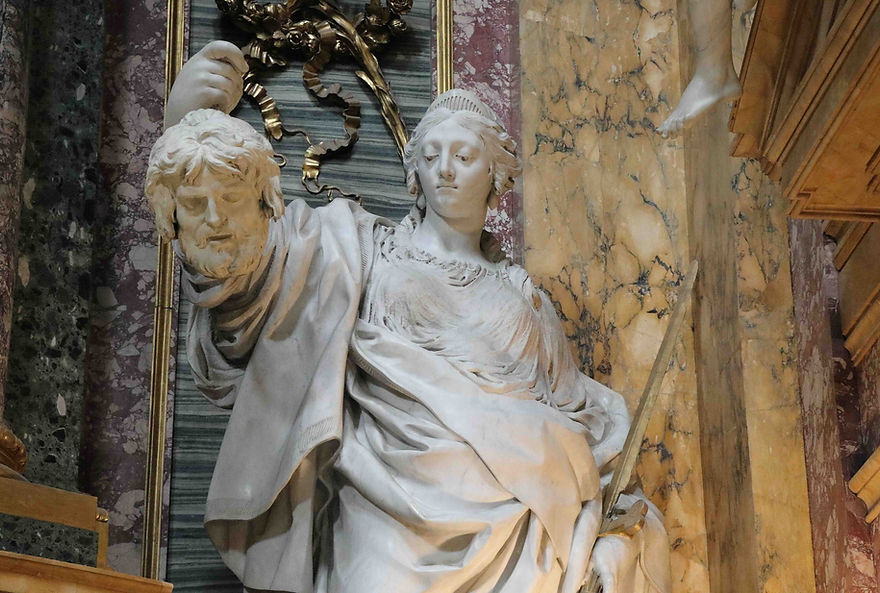
Ozias, one of the city's leaders, said to Judith: "Blessed are you, my daughter, by the Most High God, more than all the women on earth; and blessed be the Lord God, Creator of heaven and earth. For the Lord has led you to strike the head of the leader of our enemies."
The hope you have shown will never depart from the hearts of men, but they will forever remember the power of God.
Yes, may God exalt you forever, may He visit you with His blessings, for you did not spare your own life for the sake of our humbled race; you went out to prevent our ruin, walking uprightly before our God.” And all the people said, “Amen! Amen!”
Judith 13:18-20
October 26, 2025

Those who place their hope in the Lord
find new strength;
They spread out like eagles' wings,
They run tirelessly,
They walk without getting tired.
Isaiah 40:31
This message invites us to place our trust in a source greater than ourselves. It assures us that hope is not in vain: it uplifts us, strengthens us, and allows us to move forward even when the winds are contrary.
October 25, 2025
Here I am, I am with you every day.
until the end of the world.
Matthew 28:20
This promise reminds us that, no matter the circumstances, we are never alone. Even in moments of doubt or fatigue, there is a faithful presence that accompanies us, supports us, and guides us.
October 24, 2025

"Here, I am doing a new thing,
it is already in its nascent stage;
"Can't you see it?"
Isaiah 43:19
Each day holds the promise of renewal. Even in the midst of uncertainty, something beautiful can emerge. Keep your heart open, for hope doesn't shout—it whispers softly that everything can change.
October 23, 2025

“Vigilance means above all being open to Good, to Truth, to God, in the midst of a world that is often inexplicable and besieged by the power of Evil.
This means that man must strive with all his might to do what is right, not living according to his own desires, but guided by faith.
Joseph Ratzinger - Benedict XVI
October 22, 2025

25. On our journey toward the Jubilee, let us return to Sacred Scripture and listen to these words addressed to us: “This greatly encourages us who have taken refuge in the hope set before us and have taken hold of it. We have this hope as an anchor for the soul, firm and secure. It enters the inner sanctuary behind the curtain, where Jesus has gone before us to enter on our behalf” (Hebrews 6:18-20). This is a powerful invitation never to lose the hope that has been given to us, but to cling to it, finding refuge in God.
The image of the anchor aptly evokes the stability and security we possess amidst life's turbulent waters if we rely on the Lord Jesus. The storms can never overwhelm us because we are anchored in the hope of grace, which enables us to live in Christ, triumphing over sin, fear, and death. This hope, far greater than daily satisfactions and improved living conditions, sustains us through trials and compels us to walk without losing sight of the grandeur of the goal to which we are called: Heaven.
The upcoming Jubilee will therefore be a Holy Year characterized by unfading hope, the hope that resides in God. May it also help us to rediscover the necessary confidence in the Church as well as in society, in interpersonal relationships, in international relations, in the promotion of the dignity of every person, and in respect for creation. May our witness of faith be in the world a leaven of authentic hope, a proclamation of the new heavens and the new earth (cf. 2 Pet 3:13) where we will dwell in justice and harmony among peoples, striving toward the fulfillment of the Lord's promise.
Let us be drawn to hope from this day forward, and let it become contagious through us, for all who desire it. May our lives say to them: “Wait for the Lord; be strong and courageous; wait for the Lord” (Psalm 27:14). May the strength of hope fill our present, in the confident expectation of the return of the Lord Jesus Christ, to whom belong praise and glory, now and forever.
Given in Rome, at Saint John Lateran, on May 9, Solemnity of the Ascension of Our Lord Jesus Christ of the year 2024, the twelfth of my Pontificate.
Pope Francis
INDICATION BULLET FOR THE ORDINARY JUBILEE OF THE YEAR 2025
FRANÇOIS
BISHOP OF ROME SERVANT OF THE SERVANTS OF GOD
May hope fill the hearts of those who read this letter.
October 21, 2025

24. Hope finds its greatest witness in the Mother of God. In her, we see that hope is not vain optimism, but a gift of grace within the realities of life. Like any mother, every time she looked at her Son, she thought of his future, and surely the words Simeon had spoken to her in the temple remained engraved in her heart: “This child is destined to cause the falling and rising of many in Israel, and to be a sign that will be spoken against, and a sword will pierce your own soul too” (Lk 2:34-35). And at the foot of the cross, as she saw the innocent Jesus suffer and die, though overcome by immense suffering, she repeated her “yes,” without losing either hope or trust in the Lord. In this way, she collaborated with us in fulfilling what her Son had said, announcing that “the Son of Man must suffer many things and be rejected by the elders, the chief priests and the scribes, and be killed, and after three days rise again” (Mark 8:31). And in the throes of this suffering offered out of love, she became our Mother, the Mother of Hope. It is no coincidence that popular piety continues to invoke the Blessed Virgin as Stella Maris, a title that expresses the sure hope that, in the stormy vicissitudes of life, the Mother of God comes to our aid, sustains us, and invites us to have faith and to continue to hope.
In this regard, I would like to recall that the Shrine of Our Lady of Guadalupe in Mexico City is preparing to celebrate, in 2031, the 500th anniversary of the first apparition of the Virgin Mary. Through the young Juan Diego, the Mother of God conveyed a revolutionary message of hope that she still repeats today to all pilgrims and the faithful: “Am I not here, I who am your mother?” [20] A similar message is imprinted in the hearts of many Marian shrines throughout the world, destinations for countless pilgrims who entrust their anxieties, sorrows, and hopes to the Mother of God. In this Jubilee Year, shrines must be holy places of welcome and privileged spaces for fostering hope. I invite pilgrims who come to Rome to stop and pray in the Marian Shrines of the city, to venerate the Virgin Mary and invoke her protection. I am sure that all, especially those who are suffering and afflicted, will be able to experience the closeness of the most loving of mothers who never abandons her children, she who is for the holy People of God "a sign of sure hope and consolation." [21]
Pope Francis
INDICATION BULLET FOR THE ORDINARY JUBILEE OF THE YEAR 2025
FRANÇOIS
BISHOP OF ROME SERVANT OF THE SERVANTS OF GOD
May hope fill the hearts of those who read this letter.
October 20, 2025

23. Indulgence, in fact, allows us to discover how limitless God's mercy is. It is no coincidence that, in Antiquity, the term "mercy" was interchangeable with the term "indulgence," precisely because the latter is meant to express the fullness of God's forgiveness, which knows no bounds.
The Sacrament of Penance assures us that God forgives our sins. The words of the psalm return with their consoling power: “He forgives all your iniquities and heals all your diseases; he redeems your life from the pit and crowns you with love and compassion; […] The Lord is compassionate and gracious, slow to anger and abounding in love; […] He does not deal with us as our sins deserve or repay us according to our iniquities. For as high as heaven is above earth, so great is his love for those who fear him; as far as the east is from the west, so far has he removed our transgressions from us” (Psalm 103:3-4, 8, 10-12). Sacramental Reconciliation is not only a beautiful spiritual opportunity, but it represents a decisive, essential, and indispensable step on each person's journey of faith. It is there that we allow the Lord to destroy our sins, to heal our hearts, to lift us up and embrace us, to reveal to us his tender and compassionate face. Indeed, there is no better way to know God than to allow ourselves to be reconciled by him (cf. 2 Cor 5:20), savoring his forgiveness. Let us therefore not renounce Confession, but rediscover the beauty of the sacrament of healing and joy, the beauty of the forgiveness of sins!
However, as we know from personal experience, sin “leaves its mark,” it has consequences: not only external, insofar as these are the consequences of the evil committed, but also internal, insofar as “every sin, even venial, entails an unhealthy attachment to creatures, which needs purification either here below or after death in the state called purgatory.” [18] Thus, in our weak humanity, drawn to evil, there remain “residual effects of sin.” These are eliminated by indulgence, always by the grace of Christ, which is, as Saint Paul VI wrote, “our ‘indulgence.’” [19] The Apostolic Penitentiary will publish the provisions for obtaining and making effective the practice of the Jubilee Indulgence.
Such an experience of forgiveness can only open the heart and mind to forgiveness. Forgiving does not change the past and cannot alter what has already happened. But forgiveness allows us to change the future and to live differently, without rancor, resentment, or revenge. A future illuminated by forgiveness allows us to read the past with different, more serene eyes, even if they are still clouded by tears.
Pope Francis
INDICATION BULLET FOR THE ORDINARY JUBILEE OF THE YEAR 2025
FRANÇOIS
BISHOP OF ROME SERVANT OF THE SERVANTS OF GOD
May hope fill the hearts of those who read this letter.
October 19, 2025

22. Another reality linked to eternal life is God's judgment, both at the end of our existence and at the end of time. Art has often attempted to represent it—think of Michelangelo's masterpiece in the Sistine Chapel—by adopting the theological conception of the time and conveying a sense of awe to the viewer. While it is right to prepare ourselves with full awareness and seriousness for the moment that recapitulates existence, we must at the same time always do so within the dimension of hope, a theological virtue that sustains life and allows us not to succumb to fear. God's judgment, which is love (cf. 1 Jn 4:8, 16), can only be based on love, especially on how we have or have not practiced it toward the most needy, in whom Christ, the Judge himself, is present (cf. Mt 25:31-46). This is therefore a judgment different from that of men and earthly courts. It must be understood as a relationship of truth with God-love and with oneself in the unfathomable mystery of divine mercy. Sacred Scripture affirms in this regard: “By your example you taught your people that the righteous must be humane; to your children you gave a beautiful hope: after sin you grant conversion […] and [we rely] on your mercy when we are judged” (Wis 12:19, 22). As Benedict XVI wrote: “At the moment of Judgment, we experience and welcome this dominion of his love over all evil in the world and within us. The suffering of love becomes our salvation and our joy.” [17]
The judgment, therefore, concerns the salvation we hope for and which Jesus obtained for us through his death and resurrection. It is thus intended to open us to the ultimate encounter with Him. And since, in this context, we cannot believe that the evil committed remains hidden, it needs to be purified to allow the definitive passage into God's love. In this sense, we understand the necessity of praying for those who have completed their earthly journey, the solidarity in prayerful intercession that draws its efficacy from the communion of saints, from the common bond that unites us in Christ, the firstborn of creation. Thus, the Jubilee Indulgence, by virtue of prayer, is specially intended for those who have gone before us so that they may obtain full mercy.
Pope Francis
INDICATION BULLET FOR THE ORDINARY JUBILEE OF THE YEAR 2025
FRANÇOIS
BISHOP OF ROME SERVANT OF THE SERVANTS OF GOD
May hope fill the hearts of those who read this letter.
October 18, 2025

21. What then will become of us after death? With Jesus, beyond the threshold, there is eternal life, which consists in full communion with God, in contemplation and participation in his infinite love. What we experience today in hope, we will then see in reality. Saint Augustine wrote in this regard: “When I am united to you with my whole being, then there will be no more pain, no more work; my life will be fully alive, being entirely filled with you.” [16] What, then, will characterize this fullness of communion? Happiness. Happiness is the vocation of humankind, an objective that concerns everyone.
But what is happiness? What kind of happiness do we long for and desire? Not a fleeting joy, an ephemeral satisfaction that, once attained, demands ever more in a spiral of desires where the human soul is never satiated but always emptier. We need a happiness that is definitively fulfilled in that which brings us to flourish, that is, in love, so that we can say, right now: I am loved, therefore I exist; and I will always exist in the Love that never disappoints and from which nothing and no one can ever separate me. Let us recall once again the words of the apostle: "For I am convinced that neither death nor life, neither angels nor heavenly rulers, neither the present nor the future, nor any powers, neither heights nor depths, nor anything else in all creation, will be able to separate us from the love of God that is in Christ Jesus our Lord" (Rom 8:38-39).
Pope Francis
INDICATION BULLET FOR THE ORDINARY JUBILEE OF THE YEAR 2025
FRANÇOIS
BISHOP OF ROME SERVANT OF THE SERVANTS OF GOD
May hope fill the hearts of those who read this letter.
October 17, 2025

And if, faced with death—a painful separation that forces us to leave our dearest loved ones—no rhetoric is permissible, the Jubilee will offer us the opportunity to rediscover, with immense gratitude, the gift of this new life received in Baptism, capable of transfiguring the tragedy. It is important to reflect again, in the context of the Jubilee, on how this mystery has been understood since the earliest centuries of the faith. For a long time, for example, Christians built baptismal fonts in an octagonal shape, and even today we can admire many ancient baptisteries that retain this form, such as in Rome, at St. John Lateran. This indicates that, in the baptismal font, an eighth day is inaugurated, the day of the Resurrection, the day that transcends the usual rhythm marked by the weekly cycle, thus opening the cycle of time to the dimension of eternity, to life that lasts forever. This is the goal towards which we strive in our earthly pilgrimage (cf. Rom 6:22).
The most compelling testimony of this hope is offered to us by the martyrs who, steadfast in their faith in the risen Christ, were able to renounce their earthly lives rather than betray their Lord. These confessors of eternal life are present in every age, and they are numerous in our own, perhaps more so than ever before. We need to cherish their witness to make our hope fruitful.
These martyrs, belonging to different Christian traditions, are also seeds of unity because they express the ecumenism of blood. That is why I fervently hope that there will be an ecumenical celebration during the Jubilee, so that the richness of the witness of these martyrs may be highlighted.
Pope Francis
INDICATION BULLET FOR THE ORDINARY JUBILEE OF THE YEAR 2025
FRANÇOIS
BISHOP OF ROME SERVANT OF THE SERVANTS OF GOD
May hope fill the hearts of those who read this letter.
October 16, 2025
20. Jesus, who died and rose again, is the heart of our faith. Saint Paul, by stating this in few words—with only four verbs—transmits to us the “core” of our hope: “For I delivered to you as of first importance what I also received: that Christ died for our sins according to the Scriptures, that he was buried, that he was raised on the third day according to the Scriptures, and that he appeared to Peter, then to the Twelve” (1 Corinthians 15:3-5). Christ died, was buried, rose again, and appeared. He endured the drama of death for us. The Father’s love raised him from the dead in the power of the Spirit, making his humanity the firstfruits of eternity for our salvation. Christian hope consists precisely in this: faced with death, where everything seems to end, we receive the certainty that, thanks to Christ, through his grace communicated to us in Baptism, “life is not destroyed, it is transformed” [15] forever. In Baptism, in fact, buried with Christ, we receive in him, risen from the dead, the gift of a new life that breaks down the wall of death and makes it a passage to eternity.
Pope Francis
INDICATION BULLET FOR THE ORDINARY JUBILEE OF THE YEAR 2025
FRANÇOIS
BISHOP OF ROME SERVANT OF THE SERVANTS OF GOD
May hope fill the hearts of those who read this letter.
October 15, 2025

19. “I believe in eternal life”: [12] thus professes our faith. Christian hope finds a fundamental pillar in these words. It is indeed “the theological virtue by which we desire as happiness [...] eternal life.” [13] The Second Vatican Council affirms: “When divine support and the hope of eternal life are lacking, the dignity of man suffers a very serious wound, as is often seen today, and the enigma of life and death, of sin and suffering, remains unsolved. Thus, all too often, people are plunged into despair.” [14] We, on the other hand, by virtue of the hope in which we have been saved, looking at the passage of time, have the certainty that the history of humanity, and that of each individual, is not heading toward a dead end or a dark abyss, but rather toward an encounter with the Lord of glory. Let us therefore live in expectation of his return and in the hope of living forever in him. It is in this spirit that we make our own the moving invocation of the first Christians, with which Holy Scripture ends: “Come, Lord Jesus!” (Rev 22:20).
Pope Francis
INDICATION BULLET FOR THE ORDINARY JUBILEE OF THE YEAR 2025
FRANÇOIS
BISHOP OF ROME SERVANT OF THE SERVANTS OF GOD
May hope fill the hearts of those who read this letter.
October 14, 2025
18. Hope, together with faith and charity, forms the triptych of the “theological virtues” that express the essence of the Christian life (cf. 1 Cor 13:13; 1 Thess 1:3). In their inseparable dynamism, hope is what, so to speak, orients, indicates the direction and goal of the life of faith. This is why the Apostle Paul invites us: “Rejoice in hope, be patient in affliction, be constant in prayer” (Rom 12:12). Yes, we must “overflow with hope” (cf. Rom 15:13) in order to bear credible and attractive witness to the faith and love we carry in our hearts; so that faith may be joyful, charity enthusiastic; so that each person might offer even just a smile, a gesture of friendship, a fraternal glance, a sincere ear, a selfless act of service, knowing that, in the Spirit of Jesus, this can become a fruitful seed of hope for those who receive it. But what is the foundation of our hope? To understand this, it is helpful to consider the reasons for our hope (cf. 1 Peter 3:15).
Pope Francis
INDICATION BULLET FOR THE ORDINARY JUBILEE OF THE YEAR 2025
FRANÇOIS
BISHOP OF ROME SERVANT OF THE SERVANTS OF GOD
May hope fill the hearts of those who read this letter.
October 13, 2025

16. Echoing the ancient words of the prophets, the Jubilee reminds us that the earth's bounty is not meant for a privileged few, but for all. Those who possess wealth must be generous in recognizing the faces of their brothers and sisters in need. I am thinking in particular of those who lack water and food: hunger is a scandalous scourge on the body of our humanity and it calls each of us to a surge of conscience. I renew my appeal that "with the financial resources devoted to weapons and other military expenditures, a Global Fund be created with a view to eradicating hunger once and for all, and for the development of the poorest countries, so that their inhabitants do not resort to violent or deceptive solutions and do not need to leave their countries in search of a more dignified life." [8]
Pope Francis
INDICATION BULLET FOR THE ORDINARY JUBILEE OF THE YEAR 2025
FRANÇOIS
BISHOP OF ROME SERVANT OF THE SERVANTS OF GOD
May hope fill the hearts of those who read this letter.
October 12, 2025

15. I urgently appeal for hope for the billions of poor people who often lack the necessities of life. Faced with successive waves of impoverishment, there is a risk of becoming accustomed to and resigned to the situation. But we cannot turn a blind eye to the dramatic situations now found everywhere, not just in certain parts of the world. We encounter poor or impoverished people every day, some of whom may even be our neighbors. Often, they lack housing and sufficient daily food. They suffer from exclusion and the indifference of many. It is scandalous that, in a world with enormous resources largely devoted to armaments, the poor constitute "the major part [...], trillions of people." Today, they are present in international political and economic debates, but it often seems that their problems are presented as an addendum, as an issue added almost by obligation or marginally, when they are not considered mere collateral damage. In fact, when it comes to concrete action, they are frequently relegated to the last place.” [7] Let us not forget: the poor, almost always, are victims, not perpetrators.
Pope Francis
INDICATION BULLET FOR THE ORDINARY JUBILEE OF THE YEAR 2025
FRANÇOIS
BISHOP OF ROME SERVANT OF THE SERVANTS OF GOD
May hope fill the hearts of those who read this letter.
October 11, 2025

14. Older people deserve signs of hope, as they often experience loneliness and feelings of abandonment. Valuing the treasure they represent—their life experience, the wisdom they possess, and the contribution they can offer—is a commitment for the Christian community and for civil society, which are called to work together toward an alliance between generations.
I offer a special thought to grandfathers and grandmothers who represent the transmission of faith and wisdom to younger generations. They must be supported by the gratitude of children and the love of grandchildren who find in them roots, understanding, and encouragement.
Pope Francis
INDICATION BULLET FOR THE ORDINARY JUBILEE OF THE YEAR 2025
FRANÇOIS
BISHOP OF ROME SERVANT OF THE SERVANTS OF GOD
May hope fill the hearts of those who read this letter.
October 10, 2025

13. There must be signs of hope for migrants who leave their homeland in search of a better life for themselves and their families. Their hopes must not be dashed by prejudice and closed-mindedness; the welcome that embraces everyone because of their inherent dignity must be accompanied by a commitment to ensuring that no one is deprived of the right to build a better future. Many exiled, displaced, and refugee people are forced to flee due to controversial international events to escape war, violence, and discrimination. Their safety, as well as access to work and education, must be guaranteed—essential elements for their integration into their new social context.
The Christian community must always be ready to defend the rights of the most vulnerable. May it open wide its doors of welcome with generosity so that no one may ever lack the hope of a better life. May the Word of the Lord resound in hearts, who said in the great parable of the Last Judgment: “I was a stranger, and you welcomed me,” for “truly I tell you, whatever you did for one of the least of these brothers and sisters of mine, you did for me” (Matthew 25:35, 40).
Pope Francis
INDICATION BULLET FOR THE ORDINARY JUBILEE OF THE YEAR 2025
FRANÇOIS
BISHOP OF ROME SERVANT OF THE SERVANTS OF GOD
May hope fill the hearts of those who read this letter.
October 9, 2025

12. Those who, in their very being, represent hope also need signs of hope: young people. Unfortunately, they often see their dreams shattered. We cannot disappoint them: the future is built on their enthusiasm. It is wonderful to see them brimming with energy, for example, when they roll up their sleeves and voluntarily engage in situations of disaster and social unrest. But it is sad to see young people without hope. When the future is uncertain and impervious to dreams, when studies offer no opportunities, and when the lack of work or sufficiently stable employment threatens to stifle desires, it is inevitable that the present will be lived in melancholy and boredom. The illusion of drugs, the risk of transgression, and the pursuit of the ephemeral create, more so in them than in others, confusion and obscure the beauty and meaning of life, causing them to slide into dark abysses and pushing them to commit self-destructive acts. This is why the Jubilee must be an opportunity for the Church to renew its commitment to them. With renewed passion, let us care for young people, students, engaged couples, and the younger generations! Closeness to young people, joy and hope for the Church and the world!
Pope Francis
INDICATION BULLET FOR THE ORDINARY JUBILEE OF THE YEAR 2025
FRANÇOIS
BISHOP OF ROME SERVANT OF THE SERVANTS OF GOD
May hope fill the hearts of those who read this letter.
October 8, 2025

11. Signs of hope must be offered to the sick, whether they are at home or in the hospital. Their suffering must find relief in the presence of those who visit them and in the affection they receive. Works of mercy are also works of hope that awaken feelings of gratitude in hearts. And may gratitude extend to all healthcare professionals who, often in difficult conditions, carry out their mission with attentive care for the sick and the most vulnerable.
There must be inclusive care for those who, living in particularly difficult circumstances, experience their vulnerability, especially if they suffer from illnesses or disabilities that greatly limit their personal autonomy. Caring for them is a hymn to human dignity, a song of hope that calls for harmonious action from all of society.
Pope Francis
INDICATION BULLET FOR THE ORDINARY JUBILEE OF THE YEAR 2025
FRANÇOIS
BISHOP OF ROME SERVANT OF THE SERVANTS OF GOD
May hope fill the hearts of those who read this letter.
October 7, 2025

Let us pray for the hostages still held in Gaza
for two years now
10. During the Jubilee Year, we will be called to be tangible signs of hope for many brothers and sisters living in distressing conditions. I am thinking of prisoners who, deprived of their liberty, experience daily, in addition to the harshness of confinement, emotional deprivation, imposed restrictions, and, in many cases, a lack of respect.
I propose that governments, in this Jubilee Year, take initiatives that restore hope; forms of amnesty or sentence reduction aimed at helping people regain confidence in themselves and in society; pathways for reintegration into the community that correspond to a concrete commitment to respecting the laws.
The plea for acts of mercy and liberation that allow for a fresh start is an ancient call that comes from the Word of God and endures with all its wisdom: “You shall consecrate this fiftieth year and proclaim liberty to all the inhabitants of the land” (Lev 25:10). The Mosaic Law is echoed by the prophet Isaiah: “The Lord has sent me to bring good news to the poor, to heal the brokenhearted, to proclaim liberty to the captives, and release to the prisoners, to proclaim the year of the Lord’s favor” (Isa 61:1-2). These are the words that Jesus makes his own at the beginning of his ministry, declaring the “year of the Lord’s favor” fulfilled in himself (cf. Lk 4:18-19).
Pope Francis
INDICATION BULLET FOR THE ORDINARY JUBILEE OF THE YEAR 2025
FRANÇOIS
BISHOP OF ROME SERVANT OF THE SERVANTS OF GOD
May hope fill the hearts of those who read this letter.
October 6, 2025

9. Looking to the future with hope also means having an enthusiastic vision of life to pass on. Unfortunately, we must sadly acknowledge that in many situations, this vision is lacking. The first consequence is the loss of the desire to pass on life. Due to frenetic lifestyles, fears about the future, a lack of job security and adequate social protections, and social models where the pursuit of profit, rather than the care of relationships, dictates the agenda, several countries are experiencing a worrying decline in birth rates. Conversely, in other contexts, "blaming population growth, rather than the extreme and selective consumerism of some, is a way of avoiding confronting the problems." [5]
Pope Francis
INDICATION BULLET FOR THE ORDINARY JUBILEE OF THE YEAR 2025
FRANÇOIS
BISHOP OF ROME SERVANT OF THE SERVANTS OF GOD
May hope fill the hearts of those who read this letter.
October 4, 2025

8 The first sign of hope must be peace for a world once again plunged into the tragedy of war. Forgetting the dramas of the past, humanity is subjected to a new and difficult ordeal, with many populations oppressed by the brutality of violence. What have these people not endured? How is it possible that their desperate plea for help does not move national leaders to seek an end to the numerous regional conflicts, aware of the potential global consequences? Is it too much to dream that weapons will fall silent and cease bringing death and destruction? The Jubilee must remind us that those who become “peacemakers” will be “called children of God” (Mt 5:9). The need for peace calls upon everyone and demands the pursuit of concrete projects. Diplomacy must continue its commitment to creating, with courage and creativity, spaces for negotiation aimed at lasting peace.
Pope Francis
INDICATION BULLET FOR THE ORDINARY JUBILEE OF THE YEAR 2025
FRANÇOIS
BISHOP OF ROME SERVANT OF THE SERVANTS OF GOD
May hope fill the hearts of those who read this letter.
October 3, 2025

7. Besides drawing hope from God's grace, we are also called to rediscover it in the signs of the times that the Lord offers us. As the Second Vatican Council affirms, “the Church has the duty, at all times, to scrutinize the signs of the times and to interpret them in the light of the Gospel, so that she may respond, in a way appropriate to each generation, to humanity's perennial questions about the meaning of life, present and future, and about their mutual relationships.” [4] We must therefore pay attention to all the good that is present in the world so as not to fall into the temptation of considering ourselves overwhelmed by evil and violence. But the signs of the times, which contain the yearning of the human heart, in need of God's saving presence, demand to be transformed into signs of hope.
Pope Francis
INDICATION BULLET FOR THE ORDINARY JUBILEE OF THE YEAR 2025
FRANÇOIS
BISHOP OF ROME SERVANT OF THE SERVANTS OF GOD
May hope fill the hearts of those who read this letter.
October 2, 2025

In the internet age, where space and time are dominated by the “here and now,” patience is not welcome. If we were still able to look at creation with wonder, we could understand how crucial patience is. Waiting for the changing seasons and their fruits; observing the lives of animals and the cycles of their development; having the simple gaze of Saint Francis who, in his Canticle of the Creatures composed exactly 800 years ago, perceived creation as one large family and called the sun “brother” and the moon “sister.” [2] Rediscovering patience is very good for oneself and for others. Saint Paul often uses patience to emphasize the importance of perseverance and trust in what God has promised us, but above all, he testifies that God is patient with us, He who is “the God of patience and encouragement” (Rom 15:5). Patience, which is also a fruit of the Holy Spirit, keeps hope alive and strengthens it as a virtue and a way of life. Let us therefore learn to often ask for the grace of patience, which is the daughter of hope and at the same time sustains it.
Pope Francis
INDICATION BULLET FOR THE ORDINARY JUBILEE OF THE YEAR 2025
FRANÇOIS
BISHOP OF ROME SERVANT OF THE SERVANTS OF GOD
May hope fill the hearts of those who read this letter.
October 1, 2025

"We receive from God as much as we hope for."
"To expect everything from God, like a small child expects everything from his father"
"It is the path of trust and total surrender."
"My hope has never been disappointed."
Saint Thérèse of Lisieux
September 30, 2025
7. Besides drawing hope from God's grace, we are also called to rediscover it in the signs of the times that the Lord offers us. As the Second Vatican Council affirms, “the Church has the duty, at all times, to scrutinize the signs of the times and to interpret them in the light of the Gospel, so that she may respond, in a way appropriate to each generation, to humanity's perennial questions about the meaning of life, present and future, and about their mutual relationships.” [4] We must therefore pay attention to all the good that is present in the world so as not to fall into the temptation of considering ourselves overwhelmed by evil and violence. But the signs of the times, which contain the yearning of the human heart, in need of God's saving presence, demand to be transformed into signs of hope.
Pope Francis
INDICATION BULLET FOR THE ORDINARY JUBILEE OF THE YEAR 2025
FRANÇOIS
BISHOP OF ROME SERVANT OF THE SERVANTS OF GOD
May hope fill the hearts of those who read this letter.
September 29, 2025

Saint Paul is very realistic. He knows that life is made up of joys and sorrows, that love is tested when difficulties increase, and that hope seems to vanish in the face of suffering. Yet, he writes: “We also rejoice in our sufferings, because we know that suffering produces perseverance; perseverance produces character; and character produces hope” (Rom 5:3-4). For the apostle, tribulation and suffering are typical conditions for those who proclaim the Gospel in contexts of misunderstanding and persecution (cf. 2 Cor 6:3-10). In these situations, we perceive a light in the darkness. We discover how evangelization is sustained by the strength that flows from the cross and resurrection of Christ. This leads to the development of a virtue closely linked to hope: patience.
Pope Francis
INDICATION BULLET FOR THE ORDINARY JUBILEE OF THE YEAR 2025
FRANÇOIS
BISHOP OF ROME SERVANT OF THE SERVANTS OF GOD
May hope fill the hearts of those who read this letter.
September 28, 2025

Hope is born of love and is founded on the love that springs from the Heart of Jesus pierced on the cross: “For if, while we were enemies, we were reconciled to God through the death of his Son, how much more, now that we are reconciled, shall we be saved through his life!” (Romans 5:10). And his life is manifested in our life of faith, which begins with baptism, develops in docility to God’s grace, and is consequently enlivened by ever-renewed hope and made unshakeable by the action of the Holy Spirit.
Pope Francis
INDICATION BULLET FOR THE ORDINARY JUBILEE OF THE YEAR 2025
FRANÇOIS
BISHOP OF ROME SERVANT OF THE SERVANTS OF GOD
May hope fill the hearts of those who read this letter.
September 27, 2025

The Holy Spirit, through his constant presence on the Church's path, radiates the light of hope upon believers: he keeps it burning like a torch that never goes out, giving support and strength to our lives. Christian hope, in fact, neither deceives nor disappoints because it is founded on the certainty that nothing and no one can ever separate us from the love of God: “Who shall separate us from the love of Christ? Shall trouble or hardship or persecution or famine or nakedness or danger or sword? [...] No, in all these things we are more than conquerors through him who loved us.” I am convinced that neither death nor life, neither angels nor heavenly rulers, neither the present nor the future, nor any powers, neither heights nor depths, nor anything else in all creation, will be able to separate us from the love of God that is in Christ Jesus our Lord” ( Romans 8:35, 37-39) .
Pope Francis
INDICATION BULLET FOR THE ORDINARY JUBILEE OF THE YEAR 2025
FRANÇOIS
BISHOP OF ROME SERVANT OF THE SERVANTS OF GOD
May hope fill the hearts of those who read this letter.
September 26, 2025

Hope is the virtue of the young at heart; and here, age is irrelevant. For there are also elderly people with eyes full of light, who live with a constant yearning for the future. Let us think of those two great old people in the Gospel, Simeon and Anna: they never tired of waiting and saw the final stretch of their journey blessed by their encounter with the Messiah, whom they recognized in Jesus, taken to the Temple by his parents. What a grace it would be if it were so for all of us! If, after a long pilgrimage, laying down our satchels and staff, our hearts were filled with a joy never before experienced, and we too could exclaim: “Now, O Lord, you may let your servant depart in peace, according to your word, for my eyes have seen your salvation, which you have prepared in the sight of all peoples: a light for revelation to the Gentiles, and for glory to your people Israel.” (Luke 2:29-32).
Pope Francis
September 25, 2025

The world today so desperately needs this Christian virtue! The world needs hope just as much as it needs patience, a virtue that goes hand in hand with hope. Patient people are weavers of good. They persevere in their pursuit of peace, and while some are impatient and want everything immediately, patience has the capacity to wait. Even when many around them have succumbed to disillusionment, those who are filled with hope and are patient are able to weather the darkest nights. Hope and patience go hand in hand.
Pope Francis
September 24, 2025

Hope is a virtue against which we often sin: in our bitter nostalgia, in our melancholy, when we think that past happiness is buried forever. We sin against hope when we become discouraged because of our sins, forgetting that God is merciful and greater than our hearts. Let us not forget, brothers and sisters: God forgives everything, God always forgives. It is we who are tired of asking for forgiveness. But let us not forget this truth: God forgives everything, God always forgives. We sin against hope when we become discouraged in the face of our sins; we sin against hope when the autumn within us cancels out the spring; when God's love ceases to be an eternal fire and we lack the courage to make decisions that commit us for life.
Pope Francis
September 23, 2025

A Christian's hope is not due to their own merits. If they believe in the future, it is because Christ died and rose again and gave us his Spirit. "Redemption is offered to us in the sense that we have received hope, a reliable hope, by virtue of which we can face our present." In this sense, once again, we say that hope is a theological virtue: it does not originate from us, it is not an obstinacy we try to convince ourselves of, but it is a gift that comes directly from God.
Pope Francis
September 22, 2025

“Hope is the theological virtue by which we desire the kingdom of heaven and eternal life as our happiness, placing our trust in the promises of Christ and relying not on our own strength, but on the help of the grace of the Holy Spirit” (Catechism of the Catholic Church, no. 1817). These words confirm that hope is the answer offered to our hearts when the ultimate question arises within us: “What will become of me? What is the destination of this journey? What is the destiny of the world?”
Pope Francis
September 21, 2025
Dear brothers and sisters,
Let us reflect today on the virtue of hope. It is a response offered to our hearts, and without it, sadness, despair, and a sense of the futility of everything arise. Without hope, all other virtues risk crumbling and ending in ashes. It is a theological virtue, a gift from God. We often sin against hope when we become discouraged by our sins and allow autumn to erase the spring within us, or when God's love ceases to be a burning fire for us and we lack the courage to make lifelong commitments. Today, our world is in great need of this Christian virtue, which goes hand in hand with patience. Hope is the virtue of young hearts, regardless of age.
Pope Francis
September 20, 2025

We struggle to stop and rest. We live as if life were never enough. We rush to produce, to prove ourselves, to avoid losing ground. But the Gospel teaches us that knowing when to stop is an act of trust that we must learn to perform. Holy Saturday invites us to discover that life doesn't always depend on what we do, but also on how we know how to detach ourselves from what we have done.
Christian hope is not born in noise, but in the silence of an expectation filled with love. It is not the daughter of euphoria, but of trusting surrender.
The Virgin Mary teaches us this: she embodies this expectation, this trust, this hope. When it seems to us that everything is at a standstill, that life is an interrupted journey, let us remember Holy Saturday.
Even in the tomb, God prepares the greatest surprise. And if we know how to gratefully accept what has been, we will discover that, precisely in smallness and silence, God loves to transfigure reality, making all things new through the faithfulness of his love. True joy is born of contemplative waiting, patient faith, and the hope that what has been lived in love will surely rise again to eternal life.
Pope Leo XIV
September 19, 2025

“Wait for the Lord; be strong and courageous; wait for the Lord.” Psalm 26:14
Even if the week has tired you, this message invites you to draw strength from confident expectation. Hope is not passive: it strengthens, it affirms, it prepares your heart to receive what God has promised.
September 18, 2025
Let us continue without wavering to affirm our hope, for he who promised is faithful.
Let us be attentive to one another so that we may spur one another on to live in love and to do good. (Hebrews 10:23-24)
When everything around you seems to be crumbling, remember that God does not change. He is faithful to his promises, even when the time seems long or the paths dark. Hope is not just a wish—it is a certainty founded on God's faithfulness.
September 17, 2025

Here is a word of hope to brighten your day:
“For I know the plans I have for you,” declares the Lord, “plans to prosper you and not to harm you, plans to give you hope and a future.” — Jeremiah 29:11
This biblical promise reminds us that, even in times of uncertainty, God prepares a path of peace and renewal for each of us. Hope is not a passive waiting, but a living force that compels us to believe that the best is yet to come.
And as Luke 12:6-7 so aptly puts it:
“Do not be afraid: you are worth more than a multitude of sparrows.”
You are precious, and your hope is in good hands.
Pope Leo XIV
September 16, 2025

See, I am doing a new thing! Now it springs up; do you not perceive it? Yes, I am making a way in the wilderness and rivers in the desert. Isaiah 43:17
Today, God is preparing something new. Even if you only see ruins or delays, a breakthrough is brewing. Hope is believing that the desert can bloom, that silence can give birth to praise. Open your heart to God's newness.
September 15, 2025

Christian hope is not mere optimism. It is a living force, rooted in the certainty that Jesus Christ is risen and that he holds your life in his hands. Even when circumstances seem bleak, this hope reminds you that God transforms evil into good, that he heals, that he saves, and that he has not yet spoken his final word.
Today, let this hope renew you:
Believe that God works even in silence. Offer him your burdens as a prayer. Nourish your heart with his Word, which illuminates the path. And remember: “Seek first the kingdom of God and his righteousness, and all these things will be given to you as well.” — Matthew 6:33
You are never alone. Christian hope is a light that never goes out, even in the night.
September 14, 2025
Brothers and sisters, here is the road, the path to our salvation, our rebirth, and our resurrection: to look upon Jesus crucified. From this vantage point, we can see our lives and the history of our peoples in a new light. For from the Cross of Christ, we learn love, not hatred; we learn compassion, not indifference; we learn forgiveness, not revenge. The open arms of Jesus are the embrace of tenderness with which God desires to welcome us. And they show us the fraternity we are called to live among ourselves and with everyone. They show us the way, the Christian way: not the way of imposition and coercion, of power and self-importance, never the way that brandishes the cross of Christ against other brothers and sisters for whom he gave his life! The way of Jesus, the way of salvation, is different: it is the way of humble, freely given, and universal love, without "ifs" or "buts."
Pope Francis
September 13, 2025

The artist is the one who has the task of helping humanity not to lose its direction, not to lose the horizon of hope.
But be warned: this is not an easy, superficial, disembodied hope. No! True hope is intimately linked to the drama of human existence. It is not a comfortable refuge, but a fire that burns and illuminates, like the Word of God. This is why authentic art is always an encounter with mystery, with beauty that transcends us, with pain that challenges us, with truth that calls to us.
Pope Francis
September 12, 2025

"You think that no one sees your inner struggles, your hidden wounds, your unanswered prayers... But God sees everything.
He knows the weight of your sleepless nights, He hears your sighs that others ignore. And even today, He tells you: “Do not be afraid. Where you fall, I will lift you up. Where you weep, I will comfort you. Where you doubt, I will open a path for you.”
You are not abandoned. You are carried. Always.
Anonymous author
September 11, 2025
“Charity covers a multitude of sins” (1 Peter 4:8)
If we possessed charity accompanied by compassion and sorrow, we would not pay attention to the faults of our neighbor, according to the saying: “Love covers a multitude of sins” (1 Peter 4:8) and again: “Love does not dwell on wrongdoing, but excuses everything” (1 Corinthians 13:5-7). If, therefore, we had charity, charity itself would cover every fault, and we would be like the saints when they see the faults of others.
Are the saints so blind that they cannot see sins? But who hates sin as much as the saints? And yet, they do not hate the sinner, they do not judge him, they do not flee from him. On the contrary, they have compassion for him, exhort him, console him, and care for him like a sick member of his body; they do everything to save him. When a mother has a deformed child, she does not turn away from him in horror; she takes pleasure in adorning him and does everything to make him graceful. In this way, the saints always protect the sinner, prepare him, and take him under their wing to correct him at the opportune moment, to prevent him from harming another, and also to grow themselves more deeply in the charity of Christ.
Let us, therefore, also acquire charity; let us acquire mercy toward our neighbor, to guard ourselves against terrible slander, judgment, and contempt. Let us help one another as we would our own members. For “we are members of one another,” says the Apostle (Romans 12:5); “when one member suffers, all suffer together” (1 Corinthians 12:27). In short, each of us, according to our ability, strive to be united with one another. For the more we are united to our neighbor, the more we are united to God.
Dorothy of Gaza
September 10, 2025

"Blessed are you who are poor"
Since almost all people are naturally inclined to pride, the Lord begins the Beatitudes by rejecting the original sin of self-sufficiency and advising us to imitate the truly poor and willing one who is truly blessed—so that we may resemble him through voluntary poverty, according to our ability, in order to share in his beatitude, his happiness. “Let this mind be in you which was also in Christ Jesus, who, though he was in the form of God, did not consider equality with God something to be grasped, but emptied himself, taking the form of a servant” (Philippians 2:5-7).
What could be more wretched for God than to take on the condition of a slave? What could be more insignificant for the King of the universe than to share our human nature? The King of kings and Lord of lords, the Judge of the universe, pays taxes to Caesar (1 Tim 6:17; Heb 12:23; Mk 12:17). The Master of creation embraces this world, enters a cave, finds no room in an inn, and takes refuge in a stable, in the company of animals without reason. He who is pure and immaculate takes upon Himself the defilements of human nature, and after sharing all our misery, He goes so far as to experience death. Consider the immensity of His voluntary poverty! Life tastes death, the Judge is dragged before the tribunal, the Master of all life submits to a magistrate, the King of heavenly powers does not escape the hands of executioners. By this example, says the apostle Paul, his humility is measured (Phil 2:5-7).
Saint Gregory of Nyssa
September 9, 2025

"He spent the night praying to God. When day came, he called his disciples and chose twelve of them."
I believe our sisters have received the gift of joy that we see in many religious who have given themselves unreservedly to God. Our work is simply an expression of our love for God. This love needs someone to receive it, and it is in this way that the people we meet give us the means to express it.
We need to find God, and we cannot do so in turmoil or noise. God is the friend of silence. In what silence do the trees, the flowers, and the grass grow! In what silence do the stars, the moon, and the sun move! Is it not our mission to give God to the poor in the slums? Not a dead God, but a living and loving God.
The more we receive in silent prayer, the more we can give in our active lives. We need silence to be able to touch souls. The essential thing is not what we say, but what God says to us and says through us. All our words will be in vain as long as they do not come from the depths of our being; words that do not convey the light of Christ increase the darkness.
Our progress in holiness depends on God and ourselves, on God's grace and our will to be holy. We must resolutely commit ourselves to attaining holiness. "I want to be a saint" means: I want to detach myself from everything that is not God, I want to strip my heart of all created things, I want to live in poverty and detachment, I want to renounce my will, my inclinations, my whims, and my tastes, and make myself the docile servant of God's will.
Saint Teresa of Calcutta
September 8, 2025

Inner life is of paramount importance…
Active life is a consequence of inner life and only has value if it depends on it.
We want to do everything as well as possible, with perfection. But if it's not connected to our inner life, it's pointless.
The entire value of our life and activity stems from the inner life, the life of love for God and the Virgin Mary, the Immaculate, not from theories or sweetness, but the practice of a love which consists in the union of our will with the will of the Immaculate.
First and foremost, we must deepen this inner life. If it truly concerns the spiritual life, supernatural means are necessary.
Prayer, prayer and only prayer is necessary to maintain the inner life and its flourishing; inner contemplation is necessary.
Let us not worry about unnecessary things, but gently and peacefully, let us try to maintain a recollection of spirit and be open to God's grace. That is why silence helps us.
Saint Maximilian Kolbe (1894-1941), Franciscan, martyr. Unpublished spiritual conversations (trans. Lethielleux Publishers)
September 7, 2025
The mission of the Church and of every baptized person...
First and foremost, it is our personal experience of friendship with Christ that shines through in our way of life, in our attitude, in our humanity, and in the way we are able to live authentic relationships.
Evangelization is a witness to a personal encounter with Jesus Christ, the Word made flesh. It is not about transmitting an ideology or a doctrine about God. It is about transmitting the God who lives within me.
This implies a continuous and ongoing path of conversion for each of us. It means that we must constantly work on ourselves, examine our hearts, and allow ourselves to be transformed by the life of the Gospel in order to become authentic missionary disciples.
Pope Leo XIV
(July 25, 2025, address to the trainers of the Pontifical University)
September 6, 2025
