top of page


Saint Gertrude Parish - Lasne

November 9, 2025
On this page you will find:
The readings for Mass, the Mass leaflet with the choice of hymns
A sample universal prayer available for download , in PDF and editable Word formats.
A meditation on the Sunday Gospel , a spiritual text and a commentary by Marie-Noëlle Thabut
Dedication
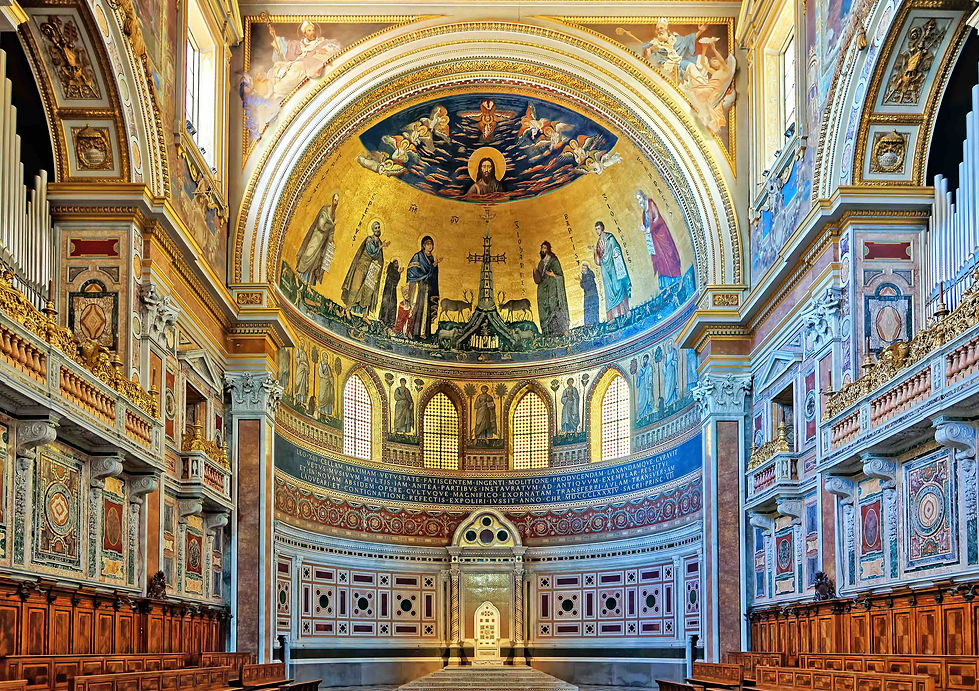
of the Lateran Basilica
Party
“I saw the water gushing from the Temple,
and all those whom this water reached were saved.”
Ezekiel 47:1-2, 8-9, 12
Readings from the Mass
Mass leaflet
Universal Prayer
Lectio Divina
Consult this page for a prayerful preparation for the liturgy and then read the meditations below.
MASS FOR THE FEAST
ON THE DEDICATION OF THE BASILICA
SAINT-JEAN-DE-LATRAN
Basilica of St. John Lateran
Saturday, November 9, 2019
[ Multimedia ]
Tonight, in this celebration of the Dedication, I would like to draw from the Word of God three verses to offer you, so that you may make them the object of your meditation and prayer.
The first, I feel, is addressed to everyone, to the entire diocesan community of Rome. It is the verse from the responsorial psalm: “A river and its streams make glad the city of God” (46:5). The Christians who live in this city are like the river that springs from the temple: they bring a Word of life and hope capable of making the deserts of hearts fruitful, just as the torrent described in Ezekiel’s vision (cf. chapter 47) makes the Arabian desert fruitful and cleanses the salty, lifeless waters of the Dead Sea. The important thing is that the stream flows from the temple and heads toward lands that appear hostile. The city cannot help but rejoice when it sees Christians become joyful heralds, determined to share with others the treasures of the Word of God and to work for the common good. The land, seemingly destined for perpetual drought, reveals extraordinary potential: it becomes a garden with evergreen trees and leaves and fruits with medicinal properties. Ezekiel explains the reason for such fertility: “Their waters spring from the sanctuary” (47:12). God is the secret of this new life-giving force!
May the Lord rejoice to see us in motion, ready to listen with our hearts to his poor who cry out to him. May Mother Church in Rome find consolation in witnessing once again the obedience and courage of her sons and daughters, full of enthusiasm for this new season of evangelization. To encounter others, to enter into dialogue with them, to listen to them with humility, generosity, and poverty of heart... I invite you to experience all of this not as a burdensome effort, but with spiritual lightness: instead of being overwhelmed by the anxiety of performance, it is more important to broaden our perception to grasp the presence and action of God in the city. This is a contemplation born of love.
To you, priests, I would like to dedicate a verse from the second reading, taken from the First Letter to the Corinthians: “For no one can lay any other foundation than the one already laid, which is Jesus Christ” (3:11). This is your task, the heart of your ministry: to help the community always remain at the Lord’s feet to listen to his Word; to keep it far from all worldliness, from all bad compromises; to preserve the holy foundations and roots of the spiritual edifice; to defend it against the ravenous wolves, against those who would lead it astray from the path of the Gospel. Like Paul, you too are “wise architects” (cf. 3:10), wise because you are well aware that any other idea or reality that we might try to lay as the foundation of the Church in place of the Gospel might perhaps guarantee us greater success, even immediate gratification, but would inevitably lead to collapse, the collapse of the entire spiritual edifice!
Since becoming Bishop of Rome, I have come to know many of you, dear priests, much better. I have admired your faith and love for the Lord, your closeness to the people, and your generosity in caring for the poor. You know the city's neighborhoods like no one else, and you hold in your hearts the faces, smiles, and tears of so many. You have set aside ideological differences and personal agendas to make room for what God asks of you. The realism of those who are grounded and know "how things work in this world" has not prevented you from soaring high with the Lord and dreaming big. May God bless you. May the joy of intimacy with Him be the truest reward for all the good you do every day.
And finally, a verse for you, members of the pastoral teams, who are here to receive a specific mission from the bishop. I could only choose it from the Gospel (Jn 2:13-22), where Jesus behaves in a divinely provocative way. In order to shake people out of their obtuseness and incite them to radical change, God sometimes chooses to act forcefully, to provoke a rupture in the situation. Through his action, Jesus wants to bring about a change of pace, a reversal of fortune. Many saints have had the same style: some of their behaviors, incomprehensible to human logic, were the fruit of intuitions stirred by the Spirit and aimed to provoke their contemporaries and help them understand that "my thoughts are not your thoughts," says God through the prophet Isaiah (55:8).
To fully understand today's Gospel passage, it's important to highlight a key detail. The merchants were in the Gentiles' courtyard, the area accessible to non-Jews. This very courtyard had been transformed into a marketplace. But God wants his temple to be a house of prayer for all peoples (cf. Isaiah 56:7). Hence Jesus' decision to overturn the money changers' tables and drive out the animals. This cleansing of the sanctuary was necessary for Israel to rediscover its vocation: to be a light for all nations, a small people chosen to serve the salvation that God wants to give to everyone. Jesus knows that this provocation will cost him dearly. And when he is asked, "What sign will you show us to prove your authority to do these things?" (v. 18), the Lord answers, "Destroy this temple, and in three days I will raise it up" (v. 19).
And it is precisely this verse that I want to share with you this evening, pastoral teams. Your mission is to help your communities and pastoral agents reach all the inhabitants of the city, finding new ways to encounter those who are far from the faith and the Church. But, in carrying out this service, bear within you this awareness, this confidence: there is no human heart in which Christ does not desire and cannot be reborn. In our lives as sinners, we often find ourselves drifting away from the Lord and quenching the Spirit. We destroy the temple of God that is each one of us. Yet, this situation is never permanent: it takes the Lord only three days to rebuild his temple within us!
No one, however wounded by evil, is condemned on this earth to be separated from God forever. In ways that are often mysterious but real, the Lord opens new perspectives in hearts, desires for truth, goodness, and beauty, which make way for evangelization. We may sometimes encounter mistrust and hostility: we must not let ourselves be hindered, but maintain the conviction that three days are enough for God to raise his Son from the dead in the heart of man. This is also the story of some of us: profound conversions, the fruit of the unpredictable action of grace! I am thinking of the Second Vatican Council: “Christ died for all, and the ultimate vocation of man is in fact one, that of God; therefore, we must consider that the Holy Spirit gives to all the possibility of being associated, in the way that God knows, with the Paschal Mystery” (Pastoral Constitution Gaudium et spes , 22).
May the Lord allow us to experience all of this in our evangelizing work. May we grow in faith in the Paschal Mystery and share in his zeal for our home. May you have a blessed journey!
Draw from the source
These days, we continue to celebrate the Church. Last Saturday and Sunday, it was the invisible Church that held our attention: the blessed and the departed who have passed from this world to the next. Today, it is a basilica of Peter that brings us together: this is the first basilica built in Rome on the Lateran Hill. Its baptistery is dedicated to Saint John the Baptist; on the façade, we can read: “Mother of all the Churches of the world.” Thus, the cathedral of Rome is not Saint Peter's Basilica, as many believe, but the Basilica of Saint John Lateran. Every year, the Roman Rite Churches celebrate the anniversary of its consecration on November 9th.
This feast invites us to recognize and celebrate God's presence among his people. This presence is a source of renewal. The first reading tells us of an extremely abundant spring of water at the entrance to the Temple. In the land of Palestine, water was rather scarce. In this account, it is considered a symbol of God's life-giving power. His presence is a source of life. The prophet announces that God is there to free us from the powers of death. He comes to place within us “a new heart and a new spirit.” In the light of the Gospel, we understand that this water symbolizes God's love, which comes to renew and sanctify us. If we are gathered here, it is to open ourselves to him and to be filled with this life-giving water.
Saint Paul's letter to the Corinthians invites us to take a further step. We are the house that God is building. This house is founded on Christ. Paul and many others after him worked to build the Christian community; this community is the temple of the new covenant. It is consecrated to the Lord. It belongs to him because it shares in the holiness of the most holy God. Any attack against the community is an attack against God. All these acts of violence that cause so much harm are a sin against God. But we have firm hope that this evil and this violence will not have the last word. Love will triumph.
The Gospel tells us about the cleansing of the Temple in Jerusalem. Jesus presents this place as “his Father’s house.” He is very angry about everything he sees there. His intention is not to defend the beauty of the place. What he denounces is the noise of money so close to the “Holy of Holies”: it is an insult to the greatness of God. Jesus asserts his right to defend this sacred place: “You are in my house: I will not let you make this place a den of robbers.”
The temple Jesus speaks of is not merely a building of stone. The disciples would later understand that it is the temple of his body. And what is extraordinary is knowing that we are all members of the Body of Christ. And today, as in the past, a great cleansing is necessary. It is no longer about animals, which were quite convenient for sacrifices. What we must sweep away is the pursuit of money, selfishness, and violence. For this, we are not alone: the Lord never ceases to reach us. He no longer needs whips and ropes. Our very encounter with him is the starting point of a renewed life. Through the sacrament of forgiveness, he comes to purify us. Where sin abounded, his love abounded all the more.
The great message of this Sunday is that Christianity is not tied to a place but to the person of Jesus Christ. Every Sunday, he joins the Christian communities gathered in his name. For us Christians, this is truly the most important moment of the entire week. We must say it again and again to those who have forgotten. We go out to do our shopping or to meet friends. Today, it is Christ who welcomes us into his house to invite us to his feast. To miss this encounter for trivial reasons would be an affront. To understand this, we must look to the cross of Christ.
If we gather in church on Sunday, it is to draw from the source of love that is in God. He is the only true temple. It is around him that all people are called to be gathered. Throughout our lives, we journey toward this great feast that will never end. On this day, we implore you, Lord, help us to build together this temple of hearts where hatred has no place.
Better understanding the Gospel
with Marie-Noëlle Thabut
Today we celebrate the feast of the dedication of the Basilica of St. John Lateran, which is the Pope's Cathedral. For the Pope, as Bishop of Rome, has a cathedral church, that is to say, a church where his seat, his cathedra, is located.
The Gospel of Saint John, which the liturgy offers for our meditation today, speaks to us of the Temple in Jerusalem. For the Jews, the Temple was the place where the glory of God rested, the place of his presence. Christians, following this interpretation, saw in the Temple the figure of the Church of Christ, animated by the Spirit of God.
The Church of Christ, alive and life-giving through the action of the Holy Spirit in each of its members—this is precisely what we commemorate on the feast of the dedication of a church. Each of us is a temple of the Holy Spirit, a living stone of this Church. Saint Paul tells us: “Do not forget that you are God’s temple and that God’s Spirit dwells in you. If anyone destroys God’s temple, God will destroy him; for God’s temple is sacred, and you are that temple” (1 Corinthians 3:16-17). By celebrating the feast of the dedication of the Basilica of Saint John Lateran, we can listen anew to these words of the Apostle Paul and allow them to sink deep within us, to savor their full meaning and be revitalized in our Christian being.
Every place reserved for divine worship is a sign of the spiritual temple that is the Church, composed of living stones, that is, of the faithful united in the one faith through participation in the sacraments and by the bond of charity. The saints are the precious stones of this edifice. Today's feast should awaken in us the desire to be saints, that is, to be those men and women consumed by zeal for the house of God (cf. Ps 68:10), totally given over to the glory of God and the reign he desires to establish at all costs in hearts, in homes, in communities, in countries, and throughout the earth.
Let us listen to what our Lord tells us: “Do not make my Father’s house a house of trade.” We are responsible for the temple of the Spirit that we are, and more broadly, for the influence of the entire Church. Within us, how many idols of our ego, false images of God before which we prostrate ourselves, with whom we bargain for this or that grace, and which bind us far more than they liberate us! Today, our God wants to deliver us so that He may come and reign as Master and Lord in each of us, and so that we may be present to His living and sanctifying presence.
We are the "temple" of God. Each and every one of us is sacred, both in body and soul. Our entire being is sacred. May we not betray this reality given to us, and thus allow God to continue shaping us each day a little more in the truth of our relationships, so that we may become a sacrament of God on earth—that is, a visible sign of His presence. Therefore, being the "temple" of God will not be merely a title for us, but a way of life, a state of faith.
“Most holy Father, eternal and almighty God, may your ever-present grace make us a temple of the Spirit, resplendent with your holiness. Day by day, sanctify the Bride of Christ, the Church, of which we are the living stones and of which our churches here below are the image, until the day she enters into the glory of heaven, happy to have given you so many children.” (Cf. 2nd preface of the Dedication)
bottom of page